
Flap Discs vs Fiber Discs: Which Abrasive Suits Your Application?
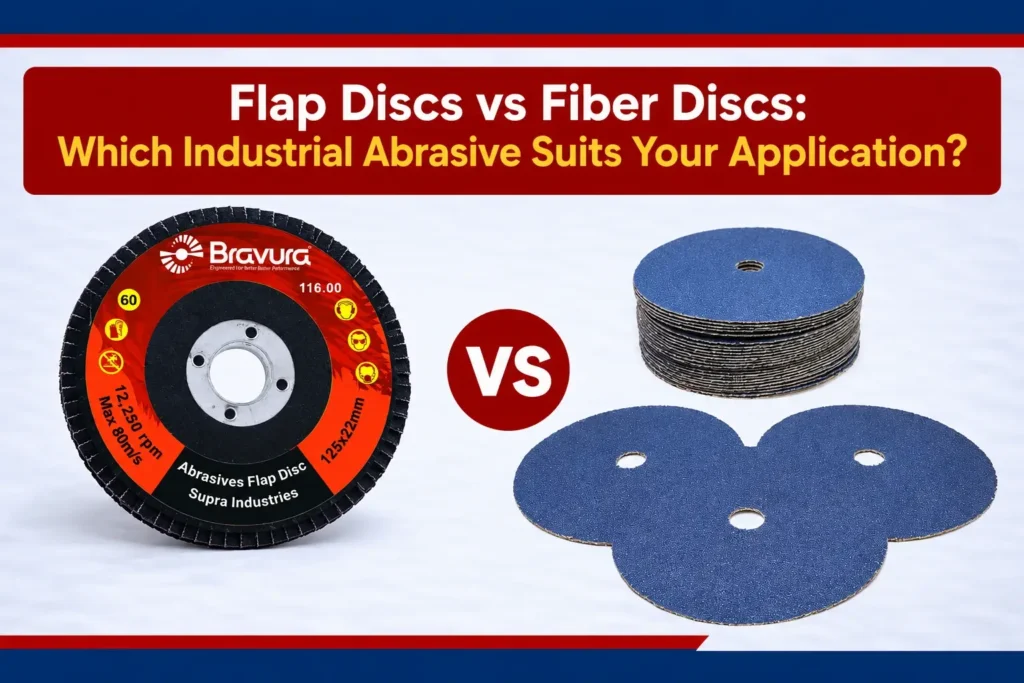
Flap discs combine overlapping coated abrasive cloth flaps on a rigid backing plate to deliver continuous grain replenishment, extended operational lifespans, and simultaneous grinding and blending, whereas resin fiber discs feature a high-density, vulcanized fiber backing that provides maximum rigidity, direct downward pressure transfer, and rapid single-pass stock removal rates (Qw). Choosing between them depends on whether your production line prioritizes the lowest initial cost-per-disc with peak cutting speed (Fiber Discs) or minimal downtime with a lower total cost-per-part via integrated multi-stage finishing (Flap Discs).
Key Takeaways for Industrial Stakeholders
- For CFOs & Procurement Officers: While fiber discs offer a 40–60% lower unit purchase cost, premium flap discs reduce consumable changeout cycles by up to 4:1, delivering a 22–35% reduction in overall cost-per-part on continuous weld-blending operations.
- For Plant Managers & Production Engineers: Vulcanized fiber discs deliver up to 30% higher initial stock removal rates on flat plane welds, but flap discs yield lower vibration harmonics (<2.5 m/s^2), superior thermal dissipation, and consistent surface roughness (Ra) values across the full usable tool life.
Comparison Matrix: Fiber Discs vs. Premium Flap Discs
| Technical Metric | Standard Vulcanized Resin Fiber Disc | Supra Industries Engineered Flap Disc | Operational & Financial Impact |
| Material Removal Rate (Qw) | Peak initial cut rate (35 – 45 g/min on carbon steel) | Moderate-high sustained cut rate (25 – 35 g/min}) | Production Output: Fiber discs lead for rapid, flat stock removal; flap discs maintain consistent removal over hours. |
| Operational Lifespan | Single-layer abrasive (15 – 30 minutes continuous duty) | Multi-layered overlapping flaps (90 – 180 minutes) | Downtime: Flap discs reduce line changeover frequency by up to 75%. |
| Substrate & Thermal Sensitivity | Susceptible to edge curl and thermal glazing above 130°C | Open-airflow radial geometry limits heat tint under 180°C | Scrap Rate: Flap discs prevent heat discoloration and work-hardening on 304/316L stainless steel. |
| Backing Dynamics | Vulcanized fiber (0.8 – 1.2 mm) requiring rigid backing pad | Fiberglass backing plate or trimmable nylon composite | Safety & Ergonomics: Integrated backing absorbs operator hand-arm vibration and resists fragmentation. |
| Surface Finish Consistency | Aggressive drop in grit profile; high risk of part gouging | Continuous fresh grain exposure preserves target Ra | Quality Assurance: Eliminates secondary blending passes before paint/passivation. |
| Procurement & Inventory TCO | Requires separate stocking of backing pads, nuts, and discs | Self-contained unit; simplifies SKU consolidation | Supply Chain: Lower order volume footprint and simplified inventory tracking. |
Technical Anatomy: Backing Structures, Grain Bond Dynamics, and Wear Profiles
Selecting the correct abrasive tool requires evaluating how the mechanical backing and bonding resins behave under normal radial loads and localized frictional heat.
RESIN FIBER DISC FLAP DISC (CONICAL TYPE 29)
(Single-Layer Coated) (Multi-Layer Overlapping)
========================= [Abrasive Grain] // // // // // [Overlapping Flaps]
————————- [Phenolic Resin] ======================= [Fiberglass Backing Plate]
######################### [Vulcanized Fiber] | |
[Requires Backing Pad] [Threaded Hub / 5/8″-11]
1. Resin Fiber Discs: Direct Force Transfer
Resin fiber discs are manufactured with a heavy-duty vulcanized fiber backing (typically 0.8 to 1.2 mm thick) coated with phenolic bond systems and a single layer of electrostatic-deposited abrasive mineral.
- Rigid Contact Arc: Because the disc is supported by a rigid polymer or ribbed rubber backing pad, nearly 100% of operator or automated tool pressure is focused directly onto the contact patch.
- Rapid Stock Removal: This high pressure-per-grain allows micro-fracturing grains like ceramic and zirconia to stay in their self-sharpening zone, making fiber discs optimal for heavy beveling, torch-cut slag removal, and flat weld leveling.
- Thermal Limitations: With only a single abrasive layer, heat concentrates quickly in the backing, making fiber discs susceptible to edge curling, thermal degradation, and glazing if dwell time exceeds operational thresholds.
2. Flap Discs: Progressive Wear and Thermal Management
Flap discs feature multiple overlapping abrasive cloth strips glued radially to a rigid fiberglass, plastic, or composite backing plate.
- Progressive Exposure Mechanism: As the outermost cloth layer wears down and the cotton/polyester backing frayed, the top binder breaks away to expose sharp, unconditioned abrasive grains beneath.
- Built-in Thermal Ventilation: The fan-like geometry of the rotating flaps draws ambient air across the interface, keeping substrate temperatures below critical thresholds (180°C) and eliminating thermal metallurgical defects on heat-sensitive alloys.
- Cushioned Grinding Action: The flex in the layered flaps dampens mechanical vibration harmonics, reducing operator fatigue and lowering the risk of accidental workpiece gouging.
Material Compatibility: Matching Grain Chemistries to Alloy Metallurgy
Both tool styles come in various grain configurations. Matching the mineral chemistry to the substrate’s mechanical properties prevents premature abrasive capping, grain pull-out, and substrate contamination.
+—————————————————————————–+
| GRAIN & FORMAT SELECTION MATRIX |
+————————–+———————–+————————–+
| SUBSTRATE METALLURGY | PRIMARY OBJECTIVE | RECOMMENDED SOLUTION |
+————————–+———————–+————————–+
| Structural Carbon Steel | Rapid Edge Beveling | Ceramic Fiber Disc |
| Heavy Plate Fabrication | Weld Seam Leveling | Zirconia Flap Disc (T29) |
| 304/316L Stainless Steel | One-Step Grind/Blend | Ceramic Flap Disc + Coat |
| Cast Iron & Hard Alloys | Gate/Riser Removal | Silicon Carbide/Cer Fiber|
| Aluminum & Non-Ferrous | Anti-Loading Grinding | Specialized A/O Flap Disc|
+————————–+———————–+————————–+
1. Ceramic Micro-Crystalline Grains (Maximum Tool Life on Superalloys)
Engineered ceramic grains fracture at the sub-micron level under sustained high-pressure grinding.
- Application Focus: Essential for aerospace components, Inconel, 316L stainless steel, and titanium.
- Top-Size Grinding Aids: Quality ceramic flap and fiber discs incorporate calcium stearate or active cryolite cooling aids to prevent loading and oxidation on stainless steel.
2. Zirconia Alumina (The Workhorse for Heavy Structural Steel)
Zirconia alumina provides high grain toughness and self-sharpening capabilities at medium-to-high working pressures.
- Application Focus: Ideal for structural I-beams, pipeline construction, heavy equipment frames, and general carbon steel fabrication.
- Wear Dynamic: Outperforms standard aluminum oxide by 2.5:1 to 3:1 in total metal removal per disc.
3. Aluminum Oxide (A/O) & Anti-Loading Formulations
Standard aluminum oxide is tough and cost-effective for medium-tensile metals, but requires stearate coatings when grinding non-ferrous metals like aluminum to prevent the soft metal from melting into the abrasive matrix.
Shape Geometry and Backing Configurations: Type 27 vs. Type 29
The geometric profile of the abrasive disc directly controls operator ergonomics, surface contact area, and the aggressiveness of the cut.
TYPE 27: FLAT PROFILE TYPE 29: CONICAL PROFILE
(Working Angle: 0° to 15°) (Working Angle: 15° to 35°)
============================= ======= =======
_____________________________ \ /
[0° – 15°] \__________/
[Flat Blending & Finishing] [15° – 35°]
[Aggressive Weld Removal]
Type 27 (Flat Face Design)
- Optimal Working Angle: 0 to 15.
- Primary Use Case: Smooth surface blending, flat sheet finishing, and cleaning planar welds.
- Surface Dynamic: Distributes force across a wider contact patch, producing uniform, low-variance Ra surface profiles without gouging adjacent base material.
Type 29 (Conical / Angled Profile)
- Optimal Working Angle: 15 to 35.
- Primary Use Case: High-pressure stock removal, edge chamfering, weld prep, and corner grinding.
- Surface Dynamic: The built-in 10 to 12 upward taper concentrates operator load onto a narrow contact line, maximizing localized force to strip heavy weld crowns rapidly.
Operating Telemetry: Surface Speed, Pressure, and Defect Prevention
Operating outside designated surface feet per minute (SFPM) or dynamic runout tolerances accelerates disc consumption and compromises operator safety.
+———————————————————————–+
| OPERATIONAL SPEED & PRESSURE THRESHOLDS |
| |
| Recommended Peripheral Speed: 12,000 – 15,500 SFPM (60 – 80 m/s) |
| Maximum Allowable Dynamic Runout: <= 0.15 mm |
| Optimal Working Pressure (Fiber): 35 – 55 N (High localized force) |
| Optimal Working Pressure (Flap): 20 – 35 N (Cushioned face contact) |
| [CRITICAL: Never exceed the rated RPM stamped on the backing flange] |
+———————————————————————–+
Common Quality Defects & Root Cause Analysis
- Defect: Thermal Heat Tinting (Blue/Purple Discoloration on Stainless)
- Root Cause: Excessive grinding pressure with an un-lubricated fiber disc; lack of top-size cooling aid; dwell time exceeding 2.5 seconds on a static point.
- Corrective Action: Switch to a conical ceramic flap disc with active cooling aid; maintain continuous stroke motion at 15 – 25.
- Defect: Edge Chipping / Flap Delamination
- Root Cause: Exceeding maximum RPM tolerances; grinding along raw, jagged flame-cut edges at an angle steeper than 45; inadequate backing support.
- Corrective Action: Reduce attack angle to 15 – 30; use high-denier polyester-backed flaps; verify spindle RPM against the ISO rated limit.
- Defect: Premature Fiber Disc Capping / Glazing
- Root Cause: Insufficient grinding force to micro-fracture ceramic/zirconia grains; using a soft, flexible backing pad for heavy beveling.
- Corrective Action: Upgrade to a rigid, ribbed aluminum or high-durometer composite backing pad to re-establish the pressure threshold required for grain micro-fracture.
Procurement Guide: Total Cost of Ownership (TCO) Calculations
Plant managers and procurement directors should evaluate the total cost equation, not just unit pricing. A lower unit cost often results in higher overall production expenses once changeover downtime and scrap rates are factored in.
+————————————————————————-+
| TOTAL COST OF OWNERSHIP (1,000 WELD SEAMS)|
+—————————–+———————+———————+
| COST FACTOR | STANDARD FIBER DISC | SUPRA FLAP DISC|
+—————————–+———————+———————+
| Discs Consumed | 100 units @ $1.50 | 25 units @ $4.20 |
| Purchase Cost | $150.00 | $105.00 |
| Changeover Downtime (mins) | 100 changes = 100m | 25 changes = 25m|
| Labor Cost ($45/hr) | $75.00 | $18.75 |
| Secondary Blending Required | Yes (Extra labor) | No (Single stage) |
| TOTAL PRODUCTION EXPENSE | $225.00 + Blending | $123.75 ALL-IN|
+—————————–+———————+———————+
| TOTAL SAVINGS WITH HIGH-PERFORMANCE FLAP DISCS: ~45% NET COST REDUCTION |
+—————————–+———————+———————+
Wholesale Supply and Custom Engineering Capabilities
Supra Industries manufactures and supplies industrial-grade abrasive components engineered for high-throughput production environments, robotic cells, and heavy fabrication shops.
- Engineered Backing Systems: High-tensile phenolic-bonded fiberglass backings with dynamic runout <= 0.08 mm, alongside trimmable polymer backings that extend usable flap length.
- Custom Grain Formulations: Custom blending of micro-crystalline ceramic, premium zirconia, and active cryolite top-sizes for specialized nuclear, marine, and defense alloys.
- B2B Procurement Programs: Volume-tier pricing, vendor-managed inventory (VMI) support, and rapid turnaround for standard and custom hub configurations (including quick-change 5/8″-11 spin-on hubs and standard 7/8″ / 22.23 mm arbors).
Request a Technical Application Audit or Bulk Quotation
Improve metal removal rates, maintain critical part tolerances, and reduce total cost per weld:
- Explore the Full Supra Industries Industrial Abrasives Catalog
- Engineering Consultation: Contact Our Technical Applications Team for grain-matching recommendations, on-site weld cell audits, and custom abrasive development.
- Commercial Procurement Inquiries: Connect directly with our wholesale team for sample testing packages, container-load pricing tiers, and OEM private-label manufacturing specifications.