
Choosing the Right Flap Wheel Grit Size for Precision Metal Polishing and Finishing
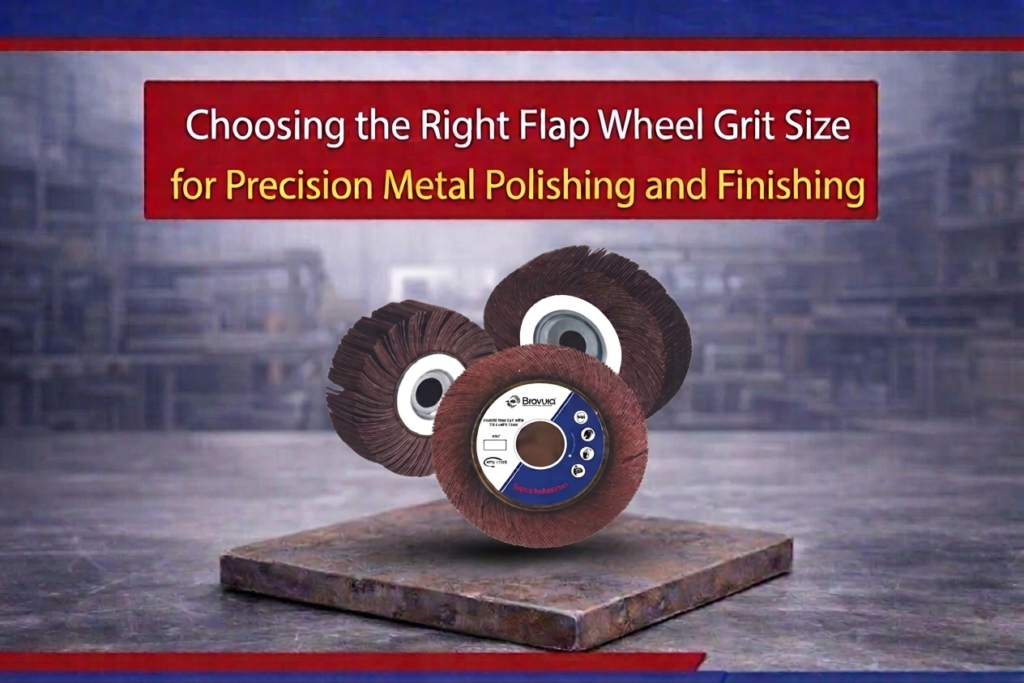
Grit selection for flap wheels is governed by three measurable factors: base metal hardness, required surface roughness (Ra), and stock removal volume. For carbon steel and stainless finishing, 40–80 grit removes weld scale and heavy stock; 120–240 grit blends transitions; 320–600+ grit achieves mirror-level Ra values below 0.4 µm.
Key Takeaways for Industrial Stakeholders
- [For CFOs/Buyers]: Standardizing on a two-stage grit progression (coarse-to-fine) instead of a five-step sequence cuts abrasive SKU inventory and per-part labor cost simultaneously.
- [For Plant/Product Managers]: Mismatched grit-to-RPM pairing is the leading cause of premature flap delamination and unplanned line downtime, not material fatigue.
- [For CFOs/Buyers]: Volume-tier pricing on ceramic-grain flap wheels typically offsets their higher unit cost within 3–5 production runs due to extended service life.
- [For Plant/Product Managers]: Verifying Shore A backing hardness before changeover reduces scrap rates on contoured or radiused parts.
Comparison Matrix: Industry-Standard Aluminum Oxide vs. Supra Industries Premium Ceramic-Grain Flap Wheels
| Metric | Industry Standard (Aluminum Oxide) | Supra Industries Premium Standard (Ceramic Grain) |
| Technical Threshold | Grain fracture onset near 550–650 N/mm² contact pressure | Rated fracture resistance above 900 N/mm² contact pressure |
| Operational Lifespan | 100–150 parts per wheel (mild steel, 60 grit) | 280–350 parts per wheel under identical load conditions |
| TCO Impact | Higher cost-per-part due to frequent changeovers and idle spindle time | Lower cost-per-part; changeover frequency reduced by ~60% |
| Procurement Risk | Variable grain wear profile across production lots | Consistent grain wear profile backed by ISO 9001:2015 manufacturing standards |
Understanding the Grit-to-Application Relationship
Grit number is an inverse measure of abrasive particle size — lower numbers correspond to coarser, larger particles designed for aggressive stock removal, while higher numbers correspond to finer particles designed for surface refinement. On flap wheels, this relationship interacts with rotational speed tolerances (RPM limits), contact arc, and feed pressure to determine both cut rate and finish quality. Selecting grit in isolation, without accounting for these interacting variables, is the most common root cause of inconsistent finish results across shifts.
- Coarse (36–60 grit): weld seam removal, scale knockdown, deburring castings.
- Medium (80–150 grit): blending, scratch pattern refinement, pre-finish leveling.
- Fine (180–320 grit): satin and brushed finishes, cosmetic-grade surfaces.
- Ultra-fine (400–600+ grit): mirror polishing, medical and food-grade component finishing.
Substrate Hardness and Grain Wear Profiles
Substrate adhesion dynamics differ substantially between grain types when polishing dissimilar metals. Aluminum oxide grain self-sharpens through fracture, exposing new cutting edges as it wears, which suits softer steels and general-purpose finishing. Ceramic grain resists fracture and instead micro-fractures at a controlled rate, extending usable wheel life on hardened stainless, titanium, and Inconel substrates where tensile shear strength at the bond line is a limiting factor.
- Aluminum oxide: general-purpose, cost-efficient on mild and low-carbon steel.
- Zirconia alumina: mid-range hardness applications, moderate heat generation.
- Ceramic grain: high-hardness alloys, extended runs, minimal thermal degradation.
Thermal Degradation Thresholds and Delamination Risk
Flap wheel backing and bonding resins begin to soften and lose adhesion integrity as sustained contact temperatures rise, with delamination under thermal stress commonly reported above 180°C on standard resin-bonded constructions. This is compounded by vibration harmonics that develop when a wheel’s dynamic balance calibration drifts out of tolerance, producing micro-fractures at the flap-to-hub bond line long before visible wear appears.
- Monitor spindle amperage draw as an early indicator of excess heat generation.
- Rotate wheel inventory to avoid prolonged idle-heat exposure in storage.
- Recheck dynamic balance after any hub or mandrel replacement.
RPM Limits and Rotational Speed Tolerances
Every flap wheel carries a maximum safe operating RPM stamped by the manufacturer, derived from the mandrel’s rotational speed tolerances and the centrifugal load the flap assembly can withstand. Operating below the rated ceiling reduces cut aggression and finish consistency; operating at or above it introduces catastrophic failure risk and voids most manufacturer safety certifications. Procurement teams should treat RPM rating as a hard compliance line item, not a negotiable spec, when auditing incoming abrasive lots.
Building a Grit Progression Schedule for Volume Production
For high-throughput lines, a documented grit progression schedule reduces variance between operators and shifts. A typical three-stage sequence for stainless steel components moving toward a #4 satin finish might run 80 grit for initial blending, 180 grit for scratch pattern refinement, and 320 grit for final satin uniformity — with Shore A hardness on the backing verified at each changeover to confirm the correct wheel family is loaded.
- Document grit sequence per part number, not per operator preference.
- Log Ra measurements at final stage to confirm repeatability against tolerance.
- Flag any deviation exceeding ±0.05 µm Ra for engineering review.
Procurement and Compliance Considerations for Bulk Buyers
Wholesale buyers evaluating flap wheel suppliers should request grain wear profile data and ISO 9001:2015 manufacturing standard certification before committing to volume-tier contracts. Lot-to-lot consistency, not sticker price alone, determines whether bulk procurement actually lowers cost-per-part once changeover labor and scrap are factored in. Supra Industries’ wholesale catalog provides tiered volume pricing alongside documented dynamic balance calibration data for every production batch, giving procurement officers an auditable basis for vendor comparison.
Plant and product managers evaluating a transition to ceramic-grain wheels, or engineering teams working through a non-standard grit progression for a difficult alloy, can route technical questions directly to Supra Industries’ custom manufacturing engineering services for application-specific guidance before committing to a production run.
Final Recommendation and Next Steps
Grit selection should be driven by measured Ra targets and substrate hardness data, not by habit or the previous supplier’s default catalog number. Plant managers auditing current finishing lines for delamination incidents or inconsistent Ra output should cross-reference their current wheel spec against the RPM rating and Shore A backing hardness before assuming the grit number itself is the problem.
For volume-tier pricing, technical datasheets, or a same-week custom flap wheel specification, submit a quote request through Supra Industries‘ wholesale procurement pipeline or connect directly with the engineering team for an application audit.