
The Ultimate Guide to Selecting the Best Abrasive for Stainless Steel Polishing
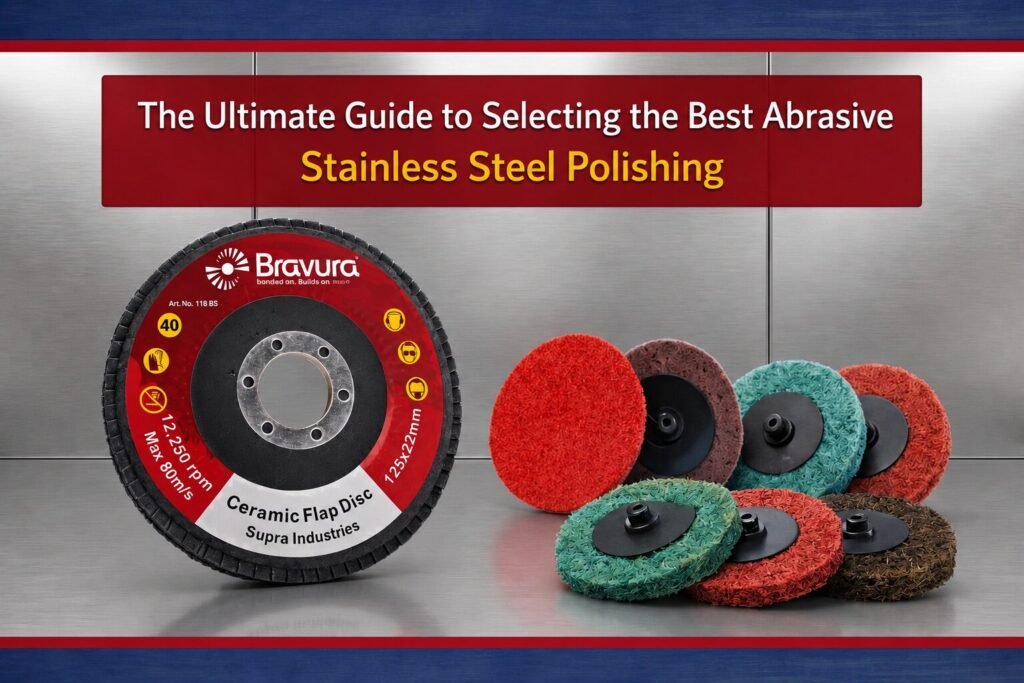
Achieving optimal surface topography on austenitic stainless steel requires high-density ceramic grains configured to fracture micro-fracture continuously under precise pressures, which limits heat retention below the 180 degree centigrade thermal degradation threshold to eliminate work-hardening and oxidation. Standard aluminum oxide alternatives fail prematurely due to grain capping and thermal loading, whereas self-sharpening ceramic configurations provide sustainable stock removal and uniform scratch patterns across high-throughput industrial production lines.
Key Takeaways for Industrial Stakeholders
- For CFOs & Procurement Officers: Upgrading to premium self-sharpening ceramic media reduces total cost of ownership (TCO) by cutting down tool replacement cycles and optimizing bulk inventory logistics.
- For Plant Managers & Production Engineers: Implementing exact-grit ceramic staging eliminates machine downtime caused by premature disc loading, while ensuring strict compliance with tight mechanical drawing tolerances.
B2B Abrasive Performance & Lifecycle Matrix
| Technical Threshold | Low-Tier Aluminum Oxide | Supra Premium Ceramic Standard |
| Grain Wear Profile | Macro-fracturing leading to premature shedding and loading | Controlled micro-fracturing providing continuous self-sharpening |
| Rotational Speed Tolerance | High degradation risk under sustained maximum RPM limits | Dynamic balance calibration maintaining stability at top RPMs |
| Thermal Degradation Threshold | Exceeded at lower friction bounds, causing surface discoloration | Resists heat up to $180^\circ\text{C}$ with active cooling top-coats |
| Operational Lifespan | 1X Baseline (Frequent changeovers required) | 3X to 5X Baseline (Reduced operational downtime) |
| TCO Impact | High cost-per-part due to labor and tool replacement rates | Lowest cost-per-part via optimized material yield |
| Procurement Risk | High batch volatility; frequent supply chain disruptions | Consistent ISO 9001:2015 certified manufacturing quality |
Phase 1: Heavy Grinding & Aggressive Stock Removal
Stainless steel alloys, particularly 304 and 316 grades, exhibit high tensile strength and significant work-hardening characteristics under mechanical stress. Standard aluminum oxide discs wear down too quickly on these hard stainless alloys because the grain dulls rapidly without fracturing, leading to high friction, extreme heat buildup, and surface burn marks. This thermal energy alters the microstructure of the metal, causing aesthetic rejection and compromising corrosion resistance.
To combat this, industrial operations must deploy Ceramic Flap Discs for a cooler cut and maximum durability on tough metals. Ceramic grains possess a unique crystalline structure that micro-fractures under heavy operational loads, continually exposing new, sharp cutting edges throughout the life of the disc.
Heavy Grinding Execution Checklist:
- Verify Durometer Ratings: Match the backup pad density precisely to the required grinding angle to prevent edge rounding.
- Monitor Rotational Speed: Maintain operational speeds slightly below the maximum structural RPM limits to prevent dynamic balance calibration drift.
- Enforce Pressure Calibration: Ensure operators apply sufficient initial pressure to initiate grain fracturing rather than allowing the disc to glaze over.
Procuring Abrasives for Heavy Metal Fabrication?
Supra Industries is a leading industrial abrasives manufacturer in India, serving sectors from automotive to aerospace. Fill out our Bulk RFQ Form below to receive a customized price list and custom grit recommendation tailored to your production floor line.
Phase 2: Weld Blending & Surface Conditioning
Once the heavy weld bead is flattened, the fabrication process transitions from aggressive stock removal to surface homogenization. The objective here is to eliminate weld marks completely without gouging the parent metal or altering structural dimensions. Heavy rigid wheels are inappropriate for this stage as their inflexibility creates flat spots on curved profiles.
Introducing Non-Woven Abrasive Wheels and Surface Conditioning Discs provides the conformability required for uniform finishes. These three-dimensional web structures distribute abrasive grains evenly across a flexible nylon matrix, allowing the tool to adapt to complex surface geometries without removing essential substrate material.
Surface Conditioning Deployment Parameters:
- Evaluate Tensile Shear Strength: Select high-density non-woven structures to prevent material tearing during high-speed edge deburring.
- Check Substrate Adhesion Dynamics: Ensure the finish profile matches subsequent coating requirements if the parts are slated for secondary plating.
- Utilize Clean and Strip Discs: Deploy open-web configurations for rapid discoloration removal without altering target dimensional tolerances.
Phase 3: Achieving a Flawless Mirror Finish
The final phase of premium stainless steel preparation demands the removal of all microscopic scratch patterns to achieve a high-gloss, reflective aesthetic. Any remaining directional lines from previous grit stages will ruin the mirror effect once the polishing compound is applied.
This stage requires detailed final buffing stages using premium wool structures to avoid micro-scratches. The natural density and elasticity of wool fibers allow them to hold polishing compounds uniformly while absorbing frictional heat, ensuring the surface transitions to a true mirror finish without clouding or burning.
Quality Assurance Buffing Steps:
- Thoroughly Clean the Workpiece: Wipe down surfaces between staging steps to prevent stray coarse grains from contaminating finer polishing pads.
- Verify Tool Dynamic Balance: Calibrate the buffing equipment to eliminate orbital flutter, which causes unwanted swirl marks.
- Verify Shore A Hardness Scales: Choose the backing material hardness carefully to match flat surfaces or contoured bends respectively.
Procuring Abrasives for Heavy Metal Fabrication?
Supra Industries is a leading industrial abrasives manufacturer in India, serving sectors from automotive to aerospace. Fill out our Bulk RFQ Form below to receive a customized price list and custom grit recommendation tailored to your production floor line.