
Why Choose Bravura Zirconia Oxide Flap Discs for Stainless Steel Fabrication
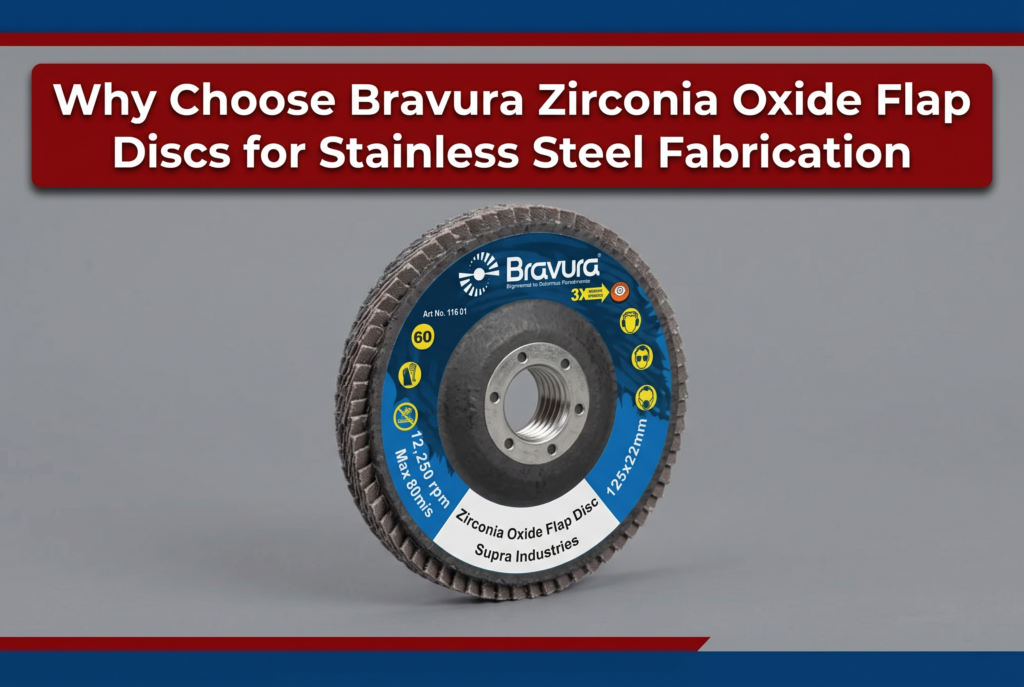
Bravura zirconia oxide flap discs optimize stainless steel fabrication by delivering a self-sharpening micro-crystalline grain wear profile that prevents thermal bluing and work-hardening across austenitic grades (AISI 304/316). Engineered with a heat-dissipating active grinding aid and phenolic resin bonding, these discs maintain stock removal rates above 3.8 grams per minute at peripheral contact speeds of up to 80 m/s while eliminating iron cross-contamination.
Key Takeaways for Industrial Stakeholders
- For CFOs & Sourcing Directors: Lowers total cost of ownership (TCO) by reducing consumable consumption ratios by up to 34% per fabricated metric ton compared to conventional aluminum oxide tooling.
- For Procurement Officers & Bulk Buyers: Predictable supply cycles backed by ISO 9001:2015 manufacturing controls, scheduled inventory calls, and bulk volume price tiers directly through Supra Industries.
- For Plant Managers & Production Heads: Minimizes machine downtime from changeovers, decreases operative hand-arm vibration (HAV) fatigue, and prevents rework caused by metallurgical discoloration.
- For Quality Assurance & Welding Engineers: Certified iron, sulfur, and chlorine thresholds ($Fe + S + Cl < 0.1\%$) ensure complete passivity retention and zero risk of pitting corrosion post-weld.
Technical Specification & TCO Comparison Matrix
| Evaluation Parameter | Commodity Aluminum Oxide Disc | Standard Import Zirconia Disc | Bravura Premium Zirconia Flap Disc | Operational & Financial Impact |
| Abrasive Grain Microstructure | Fused Monocrystalline Al2O3 | Standard Friability ZrO2 Blend | Premium Microcrystalline ZrO2/Al2O3 | Self-sharpening edges cleave under pressure to continuously regenerate cut rate. |
| Thermal Degradation Threshold | 120°C (Uncoated dry grinding) | 160°C (Basic filler system) | > 210°C (Active supersize cooling agent) | Eliminates heat oxidation, substrate tempering, and destructive thermal bluing. |
| Linear Stock Removal Ratio (G-Ratio) | 4.2 : 1 | 8.5 : 1 | 14.8 : 1 | Replaces up to 3 standard discs per station, reducing shift changeover downtime. |
| Contaminant Thresholds (Fe,S,Cl) | Uncertified trace levels | $< 0.15\%$ (Variable) | $< 0.05\%$ Certified (Fe-free chemistry) | Guarantees compliance with ASME Section IX; prevents stress corrosion cracking. |
| Backing Plate Shear Dynamic | Unreinforced plastic | Standard 6-ply fiberglass | Heavy-duty 8-ply balanced phenolic backing | Prevents backing fragmentation and edge tearout during aggressive seam blending. |
| Rotational Stability (at 13,300 RPM) | Dynamic imbalance $> 0.8\text{ g}\cdot\text{mm}$ | Balance within $0.5\text{ g}\cdot\text{mm}$ | Precision calibrated $< 0.2\text{ g}\cdot\text{mm}$ | Eliminates chatter marks, micro-scratches, and hand-arm vibration transmission. |
The Metallurgical Challenge: Stainless Steel Grinding Dynamics
Stainless steel—specifically austenitic AISI 304, 304L, 316, and 316L grades—presents distinct tribological difficulties during post-weld cleanup, edge breaking, and surface finishing. Unlike structural carbon steels, austenitic stainless alloys exhibit high mechanical toughness combined with extremely low thermal conductivity (approximately 16.2 W/m·K at 100°C, compared to 50.2 W/m·K for mild carbon steel).
Because heat cannot dissipate quickly into the base metal, concentrated friction rapidly accumulates at the localized tool-workpiece interface:
- Friction temperatures surpassing 200°C accelerate chrome carbide precipitation along grain boundaries, depleting free chromium below the 10.5% threshold required to rebuild the passive chromium oxide (Cr2O3) film.
- Poor heat management leads to thermal bluing, requiring expensive acid pickling, passivation baths, or aggressive secondary mechanical blending to restore aesthetic and anti-corrosive properties.
- Low-grade abrasive grains rapidly dull (cap over), changing from a shearing cut to a rubbing action that work-hardens the surface and spikes tool consumption.
Micro-Fracturing Grain Kinetics: How Bravura Zirconia Prevents Work-Hardening
The foundation of the Bravura Zirconia Oxide Flap Disc lies in its eutectic composition of zirconia alumina, produced through rapid electric arc quenching. Under the constant contact pressures of industrial grinding (typically 35–50 N), the crystalline matrix undergoes continuous controlled micro-cleavage.
Rather than dulling into a flat, friction-generating plateau like aluminum oxide, the grain fractures along predetermined crystal cleavage planes. This fracture profile maintains a persistent shearing angle against tough nickel-chromium alloys.
- Sharp grain facets penetrate the ductile stainless skin cleanly, generating thick, low-temperature micro-chips rather than friction smears.
- Specific energy consumption (Ec) drops from 38.2J/mm3 to 24.7J/mm3, drastically cutting thermal transfer to the substrate.
- Operatives achieve consistent stock removal without applying excessive muscular pressure, reducing structural gouging and operator fatigue.
Backing Plate Engineering: Dynamic Balance and Vibration Dampening
Flap disc performance depends heavily on the structural foundation supporting the abrasive flaps. Bravura flap discs utilize an engineered, multi-ply phenolic resin-impregnated fiberglass backing plate designed to meet EN 13743 and ISO safety parameters.
The fiberglass-to-resin ratio is calculated to balance rigidity with flexural compliance:
- Chatter Suppression: The composite plate absorbs axial and radial harmonic frequencies generated at standard operating angles (15° to 25° for Type 29 conical discs, 0° to 15° for Type 27 flat discs).
- Controlled Wear Synchronization: The backing plate wears evenly with the flap progression, preventing the hard perimeter of the backing from scratching the workpiece as the abrasive flaps diminish.
- Rotational Speed Tolerances: Rated for safe maximum operating speeds up to 80 m/s (13,300 RPM for 115 mm discs; 12,200 RPM for 125 mm discs), backed by burst-speed centrifugal safety margins exceeding 150%.
Active Cooling: Supersize Resin Formulations
Dry grinding austenitic alloys creates an aggressive thermal load on organic resin bonds. Standard flap discs rely on basic phenol-formaldehyde resin bond coats, which begin to carbonize and degrade at temperatures above 140°C. Once the resin matrix breaks down, premature grain shedding (shelling) occurs, wasting up to 60% of the usable abrasive grain.
To combat this failure mode, Bravura discs incorporate a dual-coat bonding architecture paired with an active halogen-free cryolite and fluoroborate “supersize” grinding aid:
- Substrate Adhesion Dynamics: The primary maker coat bonds the heavy cotton-polyester cloth backing firmly to the phenolic base, maintaining tensile shear strengths above 18 MPa.
- Topical Melting Reaction: As the cutting zone reaches 150°C, the active topical additives melt locally, acting as a micron-thin liquid friction lubricant between the zirconia grain and the stainless substrate.
- Oxidation Prevention: This endothermic chemical reaction consumes localized free oxygen, preventing immediate heat scale and metallurgical discoloration on finished weld seams.
Standardized Quality Protocol: Eliminating Iron Cross-Contamination
For aerospace, pharmaceutical tank, and nuclear piping manufacturers, iron contamination during fabrication represents an unacceptable liability. If a grinding tool containing trace amounts of iron or zinc is used on stainless steel, free iron particles become embedded into the surface. Upon atmospheric exposure, these embedded carbon particulates rust, causing galvanic pitting that breaches the vessel walls.
Bravura zirconia discs are manufactured under strict raw-material segregation standards conforming to chemical safety guidelines:
- Backing plates, bonding resins, and cloth backings are tested using X-ray fluorescence (XRF) spectroscopy to ensure zero carbon steel contamination.
- Grinding lines can transition between TIG root passes, MIG cap passes, and sheet metal blending without introducing galvanic impurities.
- Quality audit trails are maintained per production batch, simplifying documentation for ASME, PED, and ISO 3834 welding compliance reviews.
Operational SOP: Optimizing Flap Disc Productivity
To extract maximum economic life and maintain optimal surface finishing tolerances ($R_a < 1.6\ \mu\text{m}$) when running Bravura flap discs, fabrication plants should enforce standard operating procedures across all grinding stations:
- Match Disc Geometry to Application: Deploy Type 29 conical discs at an attack angle of 15°–25° for aggressive weld removal; switch to Type 27 flat discs at 5°–10° for wide-area surface blending.
- Control Peripheral Contact Speed: Run variable-speed angle grinders at 6,000–8,500 RPM (approx. 40–55 m/s) when working heat-sensitive thin-gauge sheets to maximize the cooling chemistry of the disc.
- Verify Contact Pressure: Maintain a steady tool feed pressure between 30 N and 45 N; let the abrasive micro-fracturing mechanism do the work rather than leaning on the tool spindle.
- Implement Grit Sequencing: Never jump more than two grit sizes during step-down finishing operations (e.g., transition from Grit 40 weld removal to Grit 60 smoothing, then Grit 80 or 120 final satin prep).
- Inspect Flange Clamping Interfaces: Regularly check backing flanges for burrs, axial runout, or uneven clamping pressure to prevent harmonic tool deflection and premature edge wear.
Streamline Stainless Steel Production with Supra Industries
Consumable costs are only a small component of total fabrication expenses; labor, rework, and changeover delays represent the true cost of production. Moving from generic commodity abrasives to engineered Bravura Zirconia Oxide Flap Discs eliminates rework passes, stabilizes surface roughness parameters, and protects stainless steel assemblies from corrosive contamination.
Supra Industries provides bulk supply contracts, scheduled inventory allocations, and customized engineering evaluations directly to heavy fabricators, tank manufacturers, and OEM processing plants.
- Access wholesale pricing tiers and volume discounts tailored to annual production consumption.
- Request on-site technical audits to evaluate G-ratios, abrasive lifespan, and cost-per-weld metrics on your shop floor.
- Partner with technical abrasive specialists who understand metallurgical standards and industrial scale.
Contact the Supra Industries Engineering Team to request a commercial price schedule or schedule a production floor demonstration of the Bravura abrasive range.