
Choosing Light Deburring Convolute Wheels for Automotive Edge Finishing
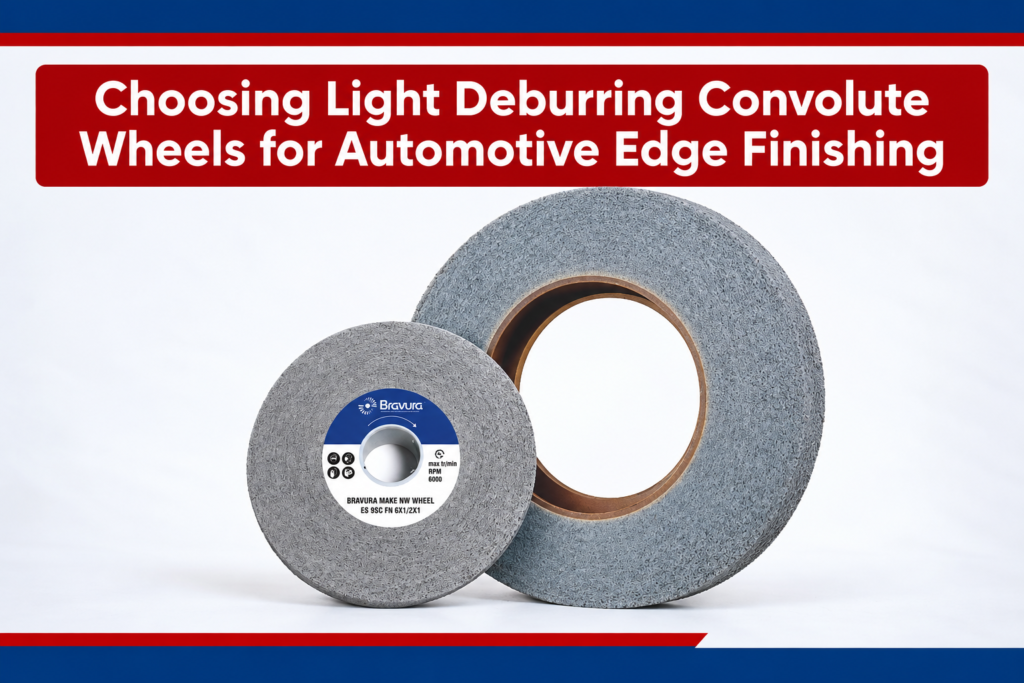
The selection of light deburring convolute wheels for automotive edge finishing requires balancing abrasive grain breakdown, non-woven nylon density, and binder thermal stability. Selecting a convolute wheel with a balanced silicon carbide or aluminum oxide grain system bound by heat-resistant polyurethane/epoxy resins directly prevents edge rounding, mitigates thermal warping on sensitive stamping alloys, and optimizes cost-per-part metrics across high-throughput production runs.
Key Takeaways for Industrial Stakeholders
- [For CFOs & Procurement Buyers]: Upgrading to non-woven convolute deburring architectures reduces abrasive wheel wear rates by up to 35%, driving down total cost of ownership (TCO) and extending replacement cycles across automated finishing cells.
- [For Plant Managers & Production Engineers]: Engineered convolute wheels maintain dimensional tolerances within 0.02mm on automotive stamping edges while eliminating secondary manual buffing operations and reducing chatter-induced scrap rates.
Convolute Wheel Performance Comparison: Standard vs. SUPRA Premium
| Performance Metric | Conventional Unitized / Cut-Rate Convolute | SUPRA High-Performance Light Deburring Wheel | TCO & Operational |
| Technical Threshold | Uneven web compression; variable density across layers | Uniform spiral-wound web with consistent binder impregnation | Eliminates gouging and maintains strict edge geometry tolerances. |
| Operational Lifespan | 40–60 continuous production hours before core breakdown | 120+ continuous production hours under standard loads | Reduces line downtime for tool changes by up to 50%. |
| TCO Impact | High rework rate due to aggressive burr gouging and thermal stress | Uniform wear profile reduces unit finishing cost by 22–30% | Decreases post-finishing quality inspection rejects significantly. |
| Procurement Risk | Inconsistent batch-to-batch density; high risk of premature delamination | ISO 9001:2015 certified production with tracked dynamic balance testing | Ensures predictable supply chain logistics and zero unexpected line stoppages. |
Technical Fundamentals of Light Deburring Convolute Wheels
Automotive edge finishing demands precise burr removal without altering the fundamental geometry of critical engine, transmission, or body components. Convolute wheels are manufactured by wrapping non-woven, resin-impregnated synthetic fiber webs around a central core under uniform tension. Unlike unitized wheels—which are compressed slab structures cut into shapes—convolute wheels must strictly rotate in their designated direction to prevent unravelling and maintain structural integrity under high centrifugal stress.
Non-Woven Nylon Matrix Dynamics
The non-woven synthetic matrix acts as a spring-like cushion that conforms to complex automotive contours. As the wheel contacts the workpiece, the nylon fibers flex, distributing mechanical force evenly across edge peaks while resisting flat-sinking into flat surfaces.
This conformability prevents edge rounding on critical automotive stamped parts such as door panels, bracket mounts, and powertrain gears.
Abrasive Grain Selection: Silicon Carbide vs. Aluminum Oxide
Selecting the correct abrasive mineral determines cut rate, surface finish, and wheel longevity:
- Silicon Carbide (SiC): Harder and sharper than aluminum oxide, SiC excels in light deburring of non-ferrous automotive components (aluminum housings, magnesium castings) and stainless steel trims where low pressure and rapid line speed are paramount.
- Aluminum Oxide (AlO): Tougher and more blocky, AlO provides high impact resistance when processing carbon steel stampings, high-strength low-alloy (HSLA) steels, and forged iron components.
Density and Grade Specifications
Wheel density ranges from soft (Density 5 or 6) for maximum conformability to hard (Density 8 or 9) for heavy edge-burr removal. For light automotive deburring, a medium density (Density 7) paired with a Fine or Very Fine grade grain size delivers optimal burr shear without generating excessive frictional heat.
Material Science & Heat Dissipation in Automotive Finishing
Automotive stamping alloys—such as 6000-series aluminum and advanced high-strength steels (AHSS)—are highly sensitive to thermal inputs. Excessive heat generated during dry deburring causes micro-structural phase changes, surface oxidation, and heat-tint discoloration that compromises subsequent electro-coating (E-coat) and paint adhesion.
Polymer Binder Stability under Thermal Stress
During continuous high-RPM deburring, contact zone temperatures can exceed $200^\circ\text{C}$. Standard resin binders breakdown thermally, causing “smearing”—a defect where melted resin transfers onto the metal surface, contaminating the workpiece and loading the wheel.
SUPRA light deburring convolute wheels utilize cross-linked thermosetting resin systems that resist thermal degradation up to $240^\circ\text{C}$, maintaining web structural integrity and preventing substrate contamination.
Airflow-Assisted Convective Cooling
The open-web structure of a convolute wheel acts as a centrifugal fan during rotation.
This continuously draws ambient air through the wheel’s internal channels, blowing away microchips and dissipating frictional heat directly at the point of contact.
Optimizing Operational Parameters for Automated & Robotic Cells
In automated robotic deburring cells, maintaining constant force, speed, and contact geometry is necessary for achieving repeatable edge radii across multi-shift operations.
Surface Feet Per Minute (SFPM) Optimization
Operating outside recommended speed thresholds accelerates wheel wear or degrades surface finish.
- Light Deburring & Deflashing: 3,000-5,000SFPM (15-25m/s)
- Blending & Fine Surface Conditioning: 5,000-7,500SFPM (25-38m/s)
Applied Force and Compliance
Excessive force degrades non-woven wheels prematurely without increasing cut rate. Robotic end-effectors should be programmed with active force control to maintain a constant contact force between 10N and 25N, allowing the abrasive grains to work efficiently without crushing the nylon fibers.
Quality Control Checklist for Robotic Deburring Operations
- Verify wheel rotation arrow matches spindle drive direction prior to mounting.
- Calibrate robotic force feedback sensors daily to maintain precise pneumatic compliance.
- Dress the convolute wheel face periodically using a silicon carbide dressing stick to maintain flatness and remove embedded contaminants.
- Monitor dynamic balance using vibration sensors to catch spindle imbalance before micro-fractures occur.
Total Cost of Ownership (TCO) Analysis for Purchasing Managers
Procurement decisions based solely on initial wheel unit price frequently result in higher operational expenses due to shortened wheel life, increased line downtime, and elevated scrap rates.
Direct Costs vs. Indirect Process Costs
- Direct Costs: Purchase price per wheel, freight, storage inventory footprint.
- Indirect Costs: Frequency of wheel changes, labor hours spent re-dressing, scrap generation from gouged edges, and downstream paint defects caused by resin smearing.
Quantifiable ROI Example
An automotive bracket production line processing 500,000 units annually upgraded from a low-tier convolute wheel to SUPRA High-Performance Light Deburring Wheels:
- Wheel Life Extension: Increased from 45 hours to 135 hours per wheel (+200%).
- Changeover Downtime Saved: 32 hours of lost production time recovered per automated cell annually.
- Scrap Reduction: Edge gouging defect rate dropped from 1.4% to 0.08%.
- Net Annual Cost Savings: Approximately $42,000 per automated deburring line.
Streamlining Procurement and Technical Support with SUPRA Industries
Selecting the correct deburring media requires direct alignment between plant engineering requirements and supply chain logistics. SUPRA Industries provides custom-engineered convolute wheels tailored to specific metal alloys, robotic cell pressures, and line speeds.
Explore the complete catalog of high-precision non-woven abrasives through the SUPRA Abrasives Wholesale Catalog, or request a consultation for custom wheel configurations, core dimensions, and density calibrations via our engineering team.