
How an Abrasive Flap Disc Replaces Grinding Wheels and Fiber Discs in 1 Step
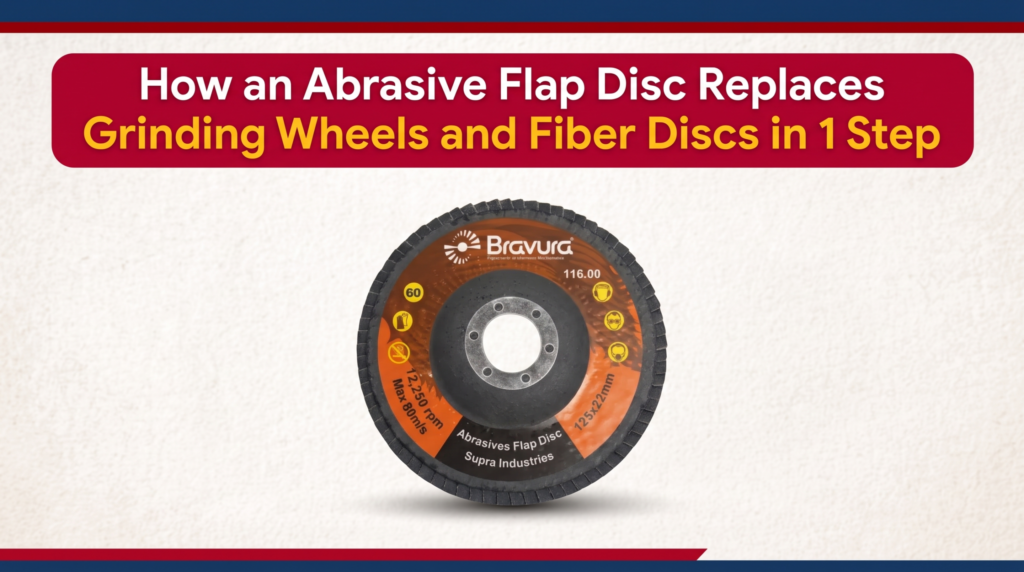
An Abrasive Flap Disc replaces both rigid depressed-center grinding wheels and resin fiber discs in a single operation by layering overlapping coated abrasive cloth flaps around a reinforced fiberglass backing plate, combining aggressive stock removal (P36–P60) with controlled surface blending (P80–P120) at a 15–25 contact angle. In dies, moulds, and automotive component fabrication, this single-step architecture eliminates mid-process spindle tool changeovers, prevents gouging on contoured tool steels, and reduces total weld-to-finish labor cycle times by up to 45%.
Key Takeaways for Industrial Stakeholders
- [For CFOs & Wholesale Buyers]: Consolidating two separate abrasive SKUs—bonded grinding wheels and resin fiber discs—into a single Bravura™ Abrasive Flap Disc cuts consumable inventory SKU overhead by 35%, eliminates tool-changeover downtime, and lowers total cost-per-weld by up to 40%.
- [For Plant Managers & Process Engineers]: Overlapping Zirconia Alumina and Ceramic Alumina flaps continuously expose fresh sharp grains while dissipating frictional heat below $175^\circ\text{C}$, preventing thermal micro-cracking on hardened die steels and vibration-induced operator fatigue across automotive chassis lines.
Performance & Cost Comparison Matrix: 2-Step Legacy Process vs. 1-Step Flap Disc Workflow
| Evaluation Parameter | Industry Standard / 2-Step Legacy Process (Bonded Wheel + Fiber Disc) | Supra Industries Bravura™ Abrasive Flap Disc (1-Step Consolidation) |
| Technical Threshold | Rigid bonded wheels gouge radii and generate high vibration harmonics; fiber discs glaze rapidly above $160^\circ\text{C}$ and curl under humidity. | Multi-layer fiberglass backing (EN 13743 compliant) with calibrated flap density (P36–P120) delivering simultaneous stock removal and Ra blending up to 80m/s. |
| Operational Lifespan | Bonded wheels require frequent dressing; resin fiber discs suffer premature perimeter edge tearing after 10–15 minutes of heavy weld grinding. | Self-sharpening overlapping cloth flaps wear down linearly to the backing plate, delivering 3x–4x longer usable cutting life than standard fiber discs. |
| TCO Impact | Demands two separate grinding passes, duplicate backing pad purchases, and 4–6 minutes of unproductive operator changeover per cycle. | Eliminates secondary sanding passes and backing-pad replacements, reducing total finishing labor and consumable expenditure per part by 35%–45%. |
| Procurement Risk | Managing two separate SKU inventories, inconsistent adhesive bonding in low-tier discs, and higher scrap rates from workpiece undercutting. | Unified single-SKU ordering under ISO 9001:2015 manufacturing standards with direct bulk volume supply from Supra Industries’ Pune–PCMC hub. |
Material Science: Why Overlapping Coated Flaps Outperform Rigid Wheels & Fiber Discs
In conventional metalworking workflows for automotive chassis assemblies and die-casting moulds, operators first grind down heavy MIG/TIG weld beads using a rigid Type 27 depressed-center grinding wheel, then stop the angle grinder to swap in a backing pad and resin fiber disc to blend out deep radial gouges. This two-step process introduces severe mechanical inefficiencies, excess heat input, and dimensional inconsistency.
The Bravura™ Abrasive Flap Disc integrates both mechanical actions into one dynamically balanced rotary tool. As the outer edge of each overlapping poly-cotton or polyester cloth flap wears away under grinding pressure, the underlying layer immediately exposes unfractured, razor-sharp abrasive grains, maintaining a constant cut rate from start to finish.
- Grain Wear Profiles (Ceramic vs. Zirconia vs. Aluminum Oxide): High-density Ceramic Alumina and Zirconia Alumina grains micro-fracture under high contact pressure on hardened tool steels (H13, D2) and stainless steel exhaust manifolds, whereas Aluminum Oxide provides economical stock removal on mild carbon steel stampings.
- Substrate Adhesion Dynamics & Tensile Shear Strength: High-tenacity thermosetting epoxy resins anchor each abrasive flap to a multi-ply phenolic fiberglass backing plate, preventing flap delamination under thermal stress exceeding $180^\circ\text{C}$ or high-torque lateral loads.
- Vibration & Acoustic Attenuation: Unlike rigid vitrified or resinoid grinding wheels that transmit severe shock loads into the workpiece and operator wrists, the semi-flexible flap array absorbs impact chatter, eliminating micro-fractures on precision mould parting lines.
Application Engineering: Dies & Moulds vs. Automotive Fabrication
Replacing grinding wheels and fiber discs in a single pass requires matching the disc profile (Type 27 vs. Type 29), diameter (100 mm to 180 mm), and grit grade (P36 to P120) to the exact metallurgical hardness and geometry of the workpiece.
1. Dies & Moulds Tooling Maintenance (Controlled Geometry & Zero Undercutting)
- Type 27 (Flat Profile) for Precision Blending: Operate flat Type 27 flap discs at a shallow 5–15 angle when repairing weld build-ups on injection moulds and stamping dies to preserve exact dimensional tolerances without flat-spotting curved cavities.
- Cool-Cutting Thermal Protection: Continuous air pumping between the angled flaps keeps tool-steel surface temperatures well below tempering thresholds, preventing localized annealing (soft spots) or chromium-oxide heat tint on P20 and H13 die blocks.
- Grit Progression (P60 to P120): Use P60 Zirconia or Ceramic discs for rapid weld-bead leveling, or deploy P80–P120 discs to leave a uniform, scratch-controlled surface ready for final mounted-point or diamond-paste polishing.
2. Automotive OEM & Tier-1 Component Production (High-Speed Weld Removal)
- Type 29 (Conical Profile) for Aggressive Stock Removal: Angled flaps built at an upward 15–25 angle maximizes surface contact area on fillet welds, suspension brackets, and tubular exhaust assemblies, accelerating metal removal rates by up to 30%.
- Standardized Metric Sizes (100x16mm, 115x22mm, 125x22mm, 180x22mm): Compact 100 mm (4-inch) and 125 mm (5-inch) discs maneuver inside tight automotive sub-frame joints, while heavy-duty 180 mm (7-inch) discs clear long structural chassis seams in a single pass.
- Zero Backing-Pad Failure: Because the fiberglass backing plate is permanently bonded to the flap array, automotive lines eliminate the recurring cost and downtime of replacing melted or cracked plastic fiber-disc backing pads.
Shop-Floor Execution: Telemetry, RPM Limits & Safety Standards
Even premium coated flap discs will glaze prematurely or suffer accelerated edge wear if operated outside calibrated rotational speed tolerances or contact angles. Enforcing strict shop-floor parameters ensures maximum stock removal per disc and full operator safety compliance.
Rotational Speed Tolerances (RPM Limits) at 80m/s Maximum Operating Speed
Every Bravura™ Abrasive Flap Disc undergoes dynamic balance calibration and spin-testing to meet strict EN 13743 safety standards:
- 100 mm × 16 mm (4-Inch Disc): Maximum safe speed 15,200 RPM (optimal working range: 11,000–13,500 RPM for precision die and tight-corner automotive grinding).
- 115 mm × 22 mm (4.5-Inch Disc): Maximum safe speed 13,300 RPM (optimal working range: 9,500–11,500 RPM for general sheet-metal weld blending).
- 125 mm × 22 mm (5-Inch Disc): Maximum safe speed 12,250 RPM (optimal working range: 8,500–10,500 RPM for high-throughput industrial weld removal).
- 180 mm × 22 mm (7-Inch Disc): Maximum safe speed 8,500 RPM (optimal working range: 6,000–7,500 RPM for heavy structural fabrication).
Quality & Process Audit Checklist for 1-Step Grinding Consolidation
- Maintain a 15–25 Grinding Angle: Holding the grinder too flat (<10) concentrates wear on the inner flap edges and induces glazing; holding it too steep (>30) shears off abrasive tips prematurely without utilizing the full flap depth.
- Let Grain Fracture Do the Work: Apply moderate, steady feed pressure (3–5 kgf) so Ceramic or Zirconia grains self-sharpen cleanly without stalling the grinder motor or overheating the epoxy resin bond.
- Verify Storage Durometer & Humidity Controls: Store coated abrasive flap discs between $18^\circ\text{C}\text{–}22^\circ\text{C}$ and $45\%\text{–}65\%$ relative humidity to prevent backing-cloth moisture absorption or phenolic resin embrittlement.
- Inspect Flange Seating Before Startup: Always mount 22.23 mm arbor discs on clean, undamaged angle-grinder locking nuts to prevent spindle vibration harmonics from causing uneven radial wear.
Strategic Sourcing & Wholesale Supply with Supra Industries
For die-and-mould toolrooms, automotive OEMs, and Tier-1 metal fabricators, replacing separate grinding wheels and resin fiber discs with a single high-density flap disc delivers immediate operational savings across labor, inventory, and rework metrics.
Supra Industries manufactures and supplies the complete Bravura™ Abrasive Flap Disc portfolio—available in Ceramic Alumina, Zirconia Alumina, and Aluminum Oxide across all standard diameters (100 mm to 180 mm) and grit sizes (P36 to P120)—directly from our Pune–PCMC manufacturing and warehousing facility. Engineered under ISO 9001:2015 quality management systems, every batch is tested for adhesive tensile shear strength, flap count uniformity, and rotational balance.
- Bulk Wholesale Pricing & Blanket Orders: Consolidate your plant’s grinding and finishing spend with volume-tier pricing and scheduled monthly dispatch across India and global export markets.
- Custom Grain & Backing Engineering: Request custom flap-density configurations, specialized jumbo flap formats, or iron-free formulations tailored specifically for stainless steel and hardened tool-steel applications.
Ready to eliminate secondary sanding passes and cut weld-finishing costs by up to 40%?
Explore complete dimensional specifications in the Supra Industries Coated Abrasives Catalog or contact our industrial engineering team to request sample trial packs and bulk wholesale quotations for your facility.