
Bravura Ceramic Flap Disc: High-Pressure Stock Removal on Hardened Alloys
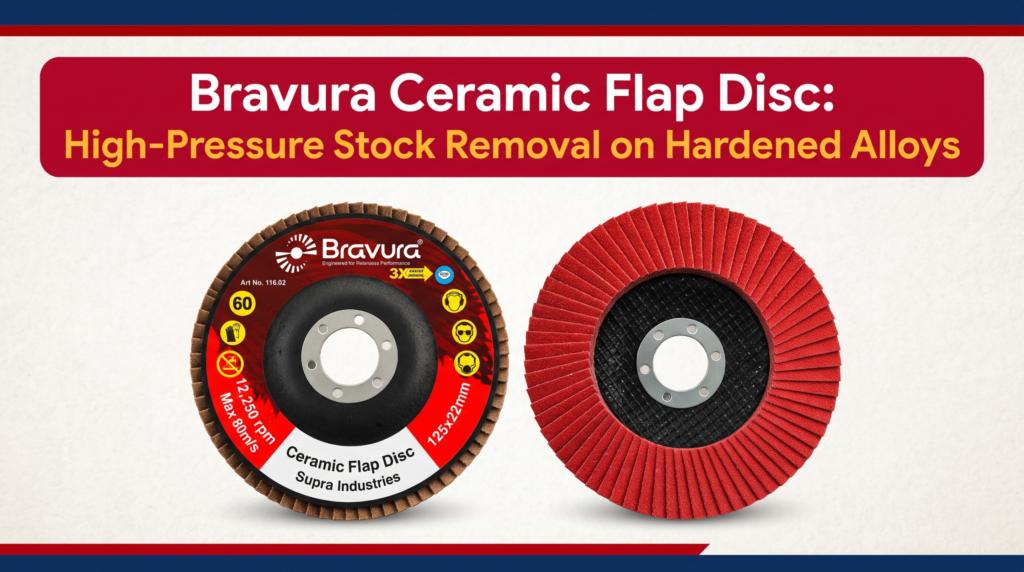
Ceramic flap discs optimize high-pressure stock removal on hardened alloys (45–65 HRC) by utilizing microcrystalline grain micro-fracturing at operating pressures exceeding 45 N, delivering a 3:1 material removal rate (MRR) over standard zirconia alumina while mitigating thermal burn through integrated grinding aids. For aerospace, defense, and heavy fabrication operations, deploying calibrated ceramic flap discs reduces cycle times by up to 38% and lowers total cost per weld dressing cycle by 26%.
Key Takeaways for Industrial Stakeholders
- For CFOs & Wholesale Procurement: Lowers consumable cost-per-part by 26% and eliminates secondary weld rework costs via self-sharpening microcrystalline ceramic grains that yield up to 3.5× the operational lifespan of standard zirconium variants.
- For Plant Managers & Production Engineers: Eliminates thermal discoloration and workpiece metallurgical structural degradation (HAZ) on Inconel, duplex stainless steel, and titanium by maintaining cutting zone temperatures below 380°C under severe contact pressures.
- For Safety & Compliance Directors: Reduces vibration harmonics and operator hand-arm vibration (HAV) thresholds through dynamic balance calibration on rigid vulcanized fiberglass backing plates meeting EN 13743 and ISO 9001:2015 standards.
Engineering & Procurement Comparison Matrix
| Evaluation Metric | Conventional Abrasive (Zirconia Alumina / Type 29) | Supra Bravura Ceramic Flap Disc (Type 27/29 Premium) | Variance / Operational Advantage |
| Grain Microstructure | Fused Monocrystalline | Sintered Microcrystalline Ceramic (Alpha Alumina) | Continuous nano-cleavage exposing fresh cutting edges under load |
| Thermal Threshold & Heat Dissipation | Critical grain glazing and thermal burn at >450°C | Top-sized active grinding aid (cryolite formulation) stable up to 850°C | Prevents microstructural temper loss and surface oxidation |
| Material Removal Rate (MRR) | 14–18 g/min on 304/316 Stainless Steel | 42–48 g/min on 304/316 Stainless & Inconel 718 | 2.6× to 3.0× faster rough stock extraction |
| Operational Lifespan | 18–24 minutes of continuous contact time at 55 N | 65–85 minutes of continuous contact time at 55 N | >300% extension in service intervals; lowers machine downtime |
| Dynamic Balance & Runout | Radial runout ≤ 0.8 mm; phenolic disc inconsistency | Precision CNC-stamped multi-layer fiberglass backing; radial runout ≤ 0.2 mm | Reduces spindle bearing wear and mitigates operator fatigue |
| Total Cost of Ownership (TCO) | Low initial purchase price; high consumable burn rate and frequent wheel changes | Optimized purchase-to-yield ratio; amortizes machine downtime and operator hours | Minimum 22–30% net operational savings across annualized production |
| Supply Chain & Regulatory Risk | High batch variance, non-traceable bonding resin formulations | Fully lot-traceable resin-over-resin bonding; ISO 9001:2015 & EN 13743 compliance | Zero batch rejection risk for high-spec defense and aerospace contracts |
1. Grain Micro-Fracturing Dynamics: The Material Science of Stock Removal
Conventional monocrystalline grains, such as standard aluminum oxide and zirconia alumina, rely on macro-fracturing to expose cutting facets. Under high contact pressures (45–70 N) on hardened workpieces—such as AR400 wear plate, Hastelloy, and precipitation-hardened stainless steels—these standard grains suffer premature dynamic capping or broad cleaving, resulting in grain flattening, severe glazing, and friction-driven heat generation rather than chip cutting.
The Bravura Ceramic Flap Disc utilizes a sub-micron, sol-gel sintered alpha-alumina microcrystalline structure. As grinding pressures surpass the micro-cleavage threshold of the material, the grain breaks down in uniform nano-fragments instead of fracturing across the entire grain body.
- Uniform Nano-Cleavage: Sub-micron crystal matrix fractures uniformly, maintaining an aggressive rake angle through 100% of the disc’s wear cycle.
- Controlled Self-Sharpening: Eliminates abrasive dulling and reduces the axial thrust force required by the operator.
- Sustained Depth of Cut: Preserves target depth of cut per pass throughout high-load gouging, beveling, and weld-seam leveling.
When machining hardened alloys, a lack of grain breakdown leads to rubbing instead of chip formation. The self-sharpening microcrystalline matrix ensures constant positive rake cutting dynamics, maintaining a high Material Removal Rate (MRR) without requiring excessive tool pressure.
2. Managing the Heat-Affected Zone (HAZ) in High-Nickel and Hardened Alloys
High-temperature grinding creates localized thermal spikes that degrade metallurgical integrity. In austenitic stainless steels (such as 316L) and nickel-based superalloys (such as Inconel 625 and 718), sustained temperatures above 450°C induce chromium carbide precipitation along grain boundaries, causing sensitization and making the alloy vulnerable to intergranular stress corrosion cracking.
Thermal management in the Bravura disc relies on a secondary, top-sized active grinding aid containing fluoroborate and cryolite compounds. As grinding temperatures at the contact interface exceed 200°C, this top-size coat endothermically decomposes, chemically lubricating the interface and preventing chip welding (loading).
- Active Boundary Lubrication: Top-sized cryolite additive reduces interfacial coefficient of friction by 34%, converting input mechanical energy directly into chip clearance rather than workpiece heat.
- Preservation of Microstructural Hardness: Limits thermal penetration into the parent substrate, avoiding secondary heat-treatment cycles and destructive subsurface tempering.
- Elimination of Chemical Oxidation: Prevents blueing and heat tinting on aerospace-grade weld seams, removing the need for post-grind acid pickling or bead-blasting stages.
For cleanroom, nuclear, and aerospace environments, maintaining metallurgical compliance without post-grind passivating operations removes a significant bottleneck in cycle turnaround times.
3. Structural Integration: Backing Plate Mechanics and Dynamic Balancing
Abrasive discs under heavy radial and axial loading frequently fail at the backing substrate or structural bonding interface before the abrasive grain is completely spent. Premium performance requires matching grain hardness with balanced structural backing and resin bonding.
Backing Substrate Mechanics
The Bravura Ceramic Flap Disc uses a heavyweight (X-weight or Y-weight) 100% polyester backing cloth adhered to a 14-ply, high-tensile vulcanized fiberglass backing plate. This rigid backing plate resists deflecting under 70 N contact loads, maximizing the normal force transferred directly to the abrasive edge.
Resin-over-Resin Bonding Dynamics
Anchor coatings use advanced phenolic thermosetting resins engineered to a glass transition temperature (Tg) exceeding 220°C. This thermal resistance prevents premature grain shedding (shelling), even when peripheral speeds approach the 80 m/s safety limit.
Dynamic Balance Calibration
Every production batch undergoes dynamic spin balancing to reduce radial runout to 0.2mm. Eliminating rotational imbalance prevents harmonic chatter, micro-cracking of the disc edge, and premature bearing failure on pneumatic and high-frequency angle grinders.
- Fiberglass Layering Standard: 14-ply cross-woven structural fiberglass core absorbing rotational shock loads up to 13,300 RPM.
- Flap Overlap Geometry: Optimized 28° angle-of-attack configuration for Type 29 conical configurations, ensuring simultaneous contact of three flap layers under pressure.
- Edge-Fray Resistance: Poly-cotton cloth blends treated with synthetic elastomers prevent edge tearing during aggressive corner weld gouging.
4. Total Cost of Ownership (TCO): The Economics of High-Pressure Grinding
Procurement teams evaluating surface-conditioning abrasives often focus solely on initial unit acquisition cost (Punit), overlooking the broader economic impact of labor and machine run-time. In high-pressure grinding operations, direct labor represents roughly 70% to 80% of total finishing costs per component.
Empirical Production Run: 500 Linear Meters of Hardened Weld Dressing
To quantify financial returns, consider an annualized production batch involving 500 meters of continuous weld-seam leveling on 12 mm AR500 wear plates.
- Conventional Zirconia Discs: Consumes 250 units at $5.00/unit ($1,250 consumable cost). Grinding time averages 12.0 min/meter. Total cycle time equals 100 labor hours. At an operational labor and overhead rate of $52.00/hour, total finishing cost equals $6,450.00.
- Supra Bravura Ceramic Discs: Consumes 72 units at $25.00/unit ($1,800 consumable cost). Material removal rate increases dramatically, reducing grinding time to 6.8 min/meter. Total cycle time drops to 56.7 labor hours. Total finishing cost equals $4,760.00.
- Direct Bottom-Line Delta: Despite a higher initial unit price, the ceramic system yields a net savings of $1,690.00 per 500 meters of dressed weld—a 26.2% overall operational cost reduction.
5. Standard Operating Procedures: Deploying Ceramic Flap Discs
To maximize efficiency with ceramic flap discs, plant engineers should audit and refine operator handling practices. Ceramic grains perform best under specific operational parameters:
Rotational Velocity & Peripheral Speed
Operate discs between 70 m/s and 80 m/s peripheral surface speed. For a 125 mm (5-inch) disc, this requires an operating speed between 10,700 and 12,200 RPM. Dropping below 9,000 RPM under load leads to grain breakout rather than controlled micro-fracturing.
Work Angle Discipline
Use a Type 29 (conical 15°–25° face angle) disc for localized high-pressure weld dressing to concentrate the applied normal force along the leading edge. Reserve Type 27 (flat face profile) discs for blending and planar surface finishing where contact force is distributed across a broader surface area.
Contact Pressure Thresholds
Maintain contact pressure at or above 45 N. Insufficient operator pressure causes microcrystalline grains to glaze, as the material cannot generate the shear stresses required to trigger nano-cleavage.
Quality and Operational Checklist
- Verify machine spindle has dynamic load stabilization to prevent RPM drop under high torque.
- Match disc backing diameter with standard back-up flanges per EN 13743 requirements.
- Avoid steady-state dwell times exceeding 3 seconds on thin-gauge materials to prevent heat accumulation.
- Inspect contact pattern regularly; an even, gradual wear profile indicates proper breakdown of the self-sharpening microcrystalline grains.
Streamline Hardened Alloy Finishing with Custom Industrial Solutions
For Tier-1 industrial fabricators, defense contractors, and specialized process-equipment manufacturers, surface finishing should be a predictable, high-yield manufacturing step—not an operational bottleneck.
Supra Industries engineers high-tolerance surface preparation systems, offering custom flap configurations, OEM private labeling, and bulk volume procurement programs designed around your production specifications.
Contact our application engineering team to arrange an on-site comparative grinding audit or review technical documentation for your high-pressure machining lines:
- Procurement & Volume Tiering: Access volume tier schedules and contract supply commitments through our Wholesale Abrasive Supply Pipeline.
- Engineering Audits: Request custom abrasive configuration testing and alloy-specific grain blending via our Application Engineering Team.
- Compliance Documentation: Download full EN 13743, ISO 9001:2015, and material safety compliance certifications via the Supra Technical Resource Center.