
How LDH Convolute Wheels Achieve Uniform Ra Finishes on Stainless Steel
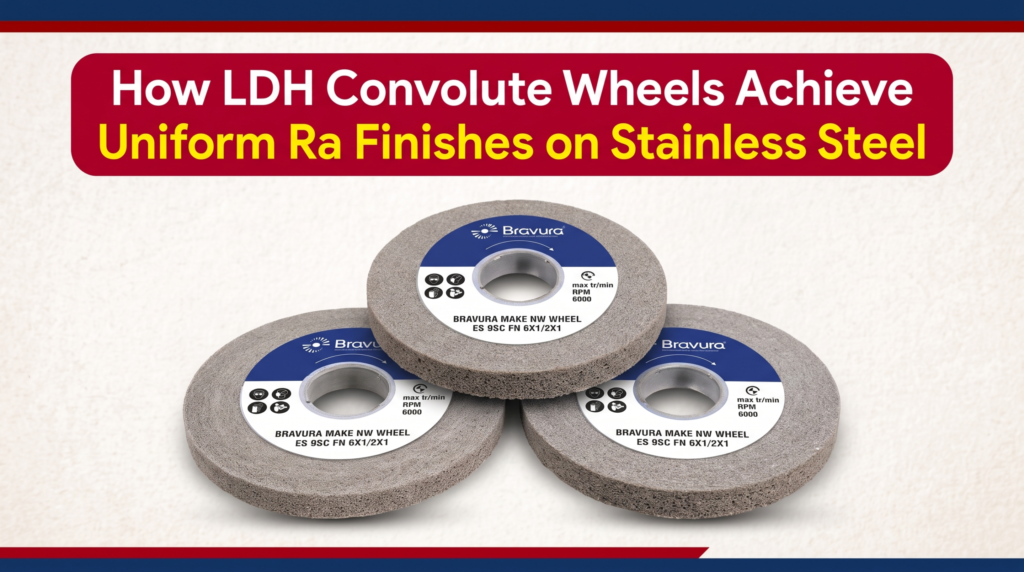
An LDH (Light Deburring High-Performance) Convolute Wheel achieves uniform surface roughness (Ra 0.2 $\mu\text{m}$ to 0.6 $\mu\text{m}$) on stainless steel by wrapping a resin-bonded, non-woven synthetic fiber web impregnated with Silicon Carbide (SiC) abrasive grains spirally around a rigid core. This spring-like, open-web compression matrix maintains constant conformability across contoured metal geometries while dissipating frictional heat below thermal oxidation thresholds, preventing workpiece smearing, micro-gouging, and dimensional tolerance drift.
Key Takeaways for Industrial Stakeholders
- [For CFOs & Wholesale Buyers]: Switching to high-density Bravura™ LDH convolute wheels reduces consumable cost-per-part by up to 24% through predictable grain attrition, eliminating secondary hand-polishing labor and stabilizing bulk inventory schedules.
- [For Plant Managers & Process Engineers]: Controlled 7S–10S web densities with Silicon Carbide (MED, FIN, VFN) grades hold tight Ra surface tolerances on AISI 304/316 stainless steel without exceeding $160^\circ\text{C}$ heat-tint thresholds or inducing spindle vibration harmonics.
Performance & Cost Comparison Matrix: Industrial Surface Conditioning
| Evaluation Parameter | Industry Standard / Low-Tier Convolute Wheel | Supra Industries Bravura™ LDH Convolute Wheel |
| Technical Threshold | Inconsistent fiber density (5S–6S) causing erratic Ra spikes ($\pm 0.35\,\mu\text{m}$); prone to resin smearing above $140^\circ\text{C}$ and out-of-round radial runout. | Precision-wound 7S, 8S, 9S, and 10S densities with calibrated Silicon Carbide grades (MED, FIN, VFN) holding $\pm 0.05\,\mu\text{m}$ Ra consistency and dynamic balance calibration. |
| Operational Lifespan | Rapid edge chunking and premature web glazing after 35–50 linear meters of stainless steel weld blending, requiring frequent manual wheel dressing. | Linear, self-refreshing fiber attrition delivers 30%–40% longer service life with low dust generation and zero core delamination under sustained lateral load. |
| TCO Impact | High hidden labor costs from secondary buffing passes, elevated scrap rates from part geometry undercutting, and frequent machine changeover downtime. | Single-pass deburring and satin finishing compresses cycle times, eliminates rework loops, and lowers total abrasive expenditure per finished component. |
| Procurement Risk | Unverified batch hardness (Durometer variance), inconsistent arbor concentricity, and erratic import lead times disrupting automated cell schedules. | ISO 9001:2015 manufacturing standards, repeatable batch-to-batch compression ratings, and direct wholesale supply from Supra Industries’ Pune–PCMC hub. |
Material Science: How Convolute Architecture Controls Ra Roughness
Unlike coated abrasive flap wheels or rigid bonded grinding stones that cut aggressively along a fixed plane, an LDH convolute wheel operates as a three-dimensional, spring-loaded abrasive matrix. During manufacturing, a continuous non-woven nylon web saturated with thermosetting phenolic resin and calibrated Silicon Carbide (SiC) abrasive grains is wound spirally under controlled tension around a reinforced core.
This convolute wrapping technique creates uniform radial density across the entire wheel face. When pressed against a stainless steel exhaust manifold, stamped automotive bracket, or sanitary food-grade vessel, the synthetic fibers compress slightly to match the micro-topography of the workpiece without altering critical part geometry.
- Substrate Adhesion Dynamics: High-tenacity phenolic and polyurethane resin binders anchor sharp Silicon Carbide crystals deep within the nylon filament intersections, preventing premature grain pull-out under high shear forces.
- Grain Wear Profiles (Silicon Carbide vs. Aluminum Oxide): While Aluminum Oxide (AO) exhibits rounded fracture toughness suited for high-tensile carbon steels, Silicon Carbide (SiC) micro-fractures into razor-sharp facets under light contact pressure—producing a cleaner, brighter, smear-free satin scratch pattern on austenitic stainless steel (AISI 304 and 316).
- Open-Web Thermal Dissipation: The porous, semi-open structure acts as an internal centrifugal fan during rotation, pulling ambient air through the contact zone to keep interface temperatures well below the $180^\circ\text{C}$ thermal degradation threshold where resin smearing and chromium-oxide heat tint occur.
Density & Grade Calibration for Automotive and Metal Fabrication
Selecting the exact specification within the Bravura™ LDH Convolute Wheel lineup prevents both under-cutting (leaving residual micro-burrs) and over-cutting (flattening precision radii). Engineers calibrate wheel selection using two primary variables: Web Density (7S–10S) and Abrasive Grit Grade (MED, FIN, VFN).
1. Selecting Web Density (Durometer & Compression Resistance)
Density dictates how aggressively the wheel holds its profile against sharp edges versus how easily it conforms to curved surfaces.
- 7S Density (Medium-Conformable): Engineered for contoured automotive trim, tubular exhaust bends, and stamped sheet metal where the wheel must wrap gently around curved profiles without gouging.
- 8S Density (General-Purpose Industrial Standard): Balances edge retention with surface conformability for blending TIG/MIG weld seams and removing CNC machining marks.
- 9S & 10S Density (High-Durability Edge Retention): High-compression structures built for heavy-duty edge deburring on laser-cut stainless steel blanks, punched holes, and precision hydraulic components where flat profile stability is mandatory.
2. Matching Abrasive Grade to Target Ra Thresholds
Surface roughness (Ra, measured in micrometers) directly governs corrosion resistance and cleanability in automotive, pharmaceutical, and architectural stainless steel assemblies.
- MED (Medium Silicon Carbide): Removes medium burrs, coarse mill scale, and 120-grit coated belt scratches, establishing an initial uniform satin base (Ra $0.6\,\mu\text{m} – 0.8\,\mu\text{m}$).
- FIN (Fine Silicon Carbide): Blends machine tool marks and refines surfaces to a standard architectural No. 4 brushed finish (Ra $0.4\,\mu\text{m} – 0.6\,\mu\text{m}$) in a single pass.
- VFN (Very Fine Silicon Carbide): Delivers final cosmetic conditioning and pre-buffing refinement (Ra $0.2\,\mu\text{m} – 0.35\,\mu\text{m}$), reducing surface micro-pits and extending pitting corrosion resistance in chloride-rich environments.
Operational Parameters: Preventing Failure Modes on the Shop Floor
Even premium non-woven wheels fail prematurely when operated outside calibrated spindle parameters. Vibration harmonics, excessive contact pressure, and improper rotational direction account for over 70% of premature convolute wheel glazing and workpiece rejection.
Rotational Speed Tolerances (RPM Limits) & Surface Speed
Convolute wheels rely on optimal surface feet per minute (SFPM)—typically 4,500 to 6,500 SFPM for stainless steel—to allow individual Silicon Carbide grains to shear metal cleanly without generating frictional heat.
- 6-Inch (150 mm) Outer Diameter: Operate between 3,000 and 4,200 RPM (maximum safe operating speed: 6,000 RPM) for controlled bench-motor and robotic cell deburring.
- 8-Inch (200 mm) Outer Diameter: Operate between 2,200 and 3,200 RPM (maximum safe operating speed: 4,500 RPM) to maintain linear scratch consistency across wide sheet panels.
- 10-Inch & 12-Inch (250–300 mm) Outer Diameter: Operate between 1,500 and 2,400 RPM on stationary pedestal buffers and automated centerless tube-polishing lines.
Shop-Floor Execution Checklist for Zero-Defect Finishing
- Verify Directional Arrow Alignment: Always mount the wheel so spindle rotation matches the directional arrow printed on the core; running a convolute wheel backward causes immediate layer delamination and fiber unwinding.
- Apply Light-to-Moderate Contact Pressure: Let the tips of the Silicon Carbide fibers perform the cutting action; excessive operator force crushes the open-web structure, induces resin smearing above $180^\circ\text{C}$, and creates dark heat-tint bands.
- Inspect Arbor Concentricity & Flanges: Use matched, dynamically balanced mounting flanges covering at least one-third of the wheel diameter (1”, 3”, or 5” inner diameter bores) to eliminate spindle vibration harmonics that cause chatter marks.
- Maintain Low-Dust, High-Efficiency Air Filtration: Bravura™ LDH wheels are formulated for ultra-low dust generation compared to conventional open-mesh pads, protecting operator respiratory health and preventing conductive metallic dust buildup inside CNC servo drives.
Strategic Sourcing & Custom Engineering with Supra Industries
For Tier-1 automotive component manufacturers, stainless steel equipment fabricators, and OEM procurement teams, consistent surface finish repeatability is non-negotiable. Sourcing fragmented, inconsistent abrasives leads to unpredictable cycle times, unscheduled line stoppages, and failed quality audits.
Supra Industries manufactures and supplies the complete Bravura™ Non-Woven Convolute Wheel portfolio—including LDH (Light Deburring High-Performance), LDP, Rapid Finish, and Multi-Finish configurations—directly from our Pune–PCMC industrial manufacturing and warehousing hub. Available in outer diameters from 6” to 12” and thicknesses from 1/2” up to 35” custom wide-face rolls, our wheels are engineered for seamless integration into manual pedestal grinders, semi-automatic backstand setups, and robotic finishing cells.
- Custom Dimensional & Density Engineering: Request tailored bore sizes, specialized face widths, or custom density-grade pairings matched to your plant’s exact Ra profilometer targets.
- Reliable Bulk Supply & Volume Tier Pricing: Eliminate import bottlenecks with domestic Indian manufacturing, strict ISO 9001:2015 batch traceability, and scheduled blanket-order deliveries.
Ready to standardize your stainless stee
l Ra finishes and cut abrasive consumable costs?
Explore technical specifications in the Supra Industries Convolute Wheels Catalog or contact our application engineering team today to schedule an on-site abrasive audit and request bulk wholesale pricing for your facility.