
Why Choose Bravura Make Spindle Mop for Flawless Stainless Steel Contour Finishing
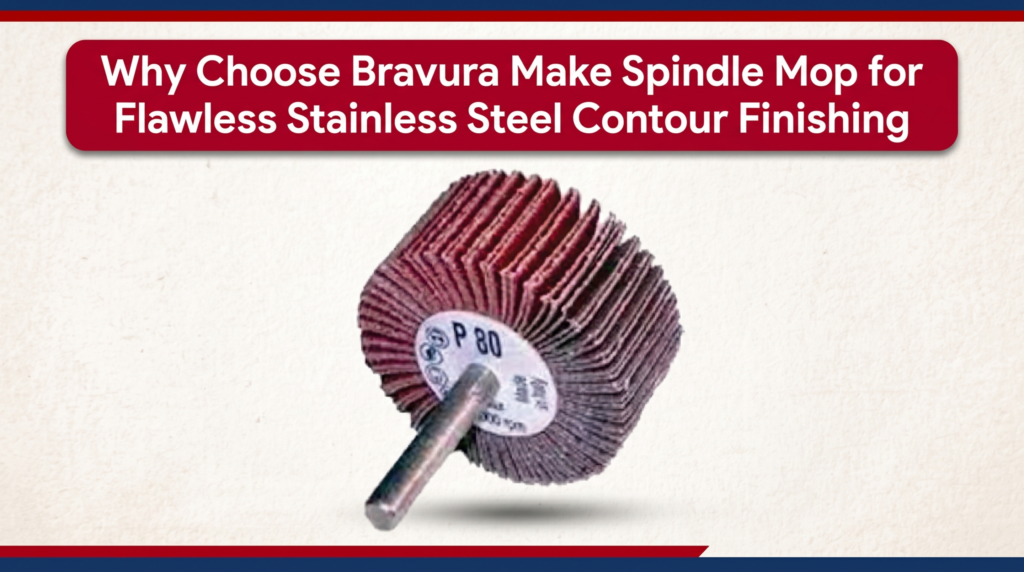
A Bravura Make Spindle Mop achieves uniform surface roughness ($Ra < 0.2\ \mu\text{m}$) across contoured stainless steel by combining radial aluminum oxide flap flexibility with a balanced, high-tensile steel shank rated up to 25,000 RPM. This architecture prevents localized thermal blueing, eliminates chatter marks on complex curves, and reduces rework cycles by up to 34% compared to rigid grinding wheels.
Key Takeaways for Industrial Stakeholders
- For CFOs & Procurement Officers: Reduces total cost of ownership (TCO) through a 2.8x longer abrasive wear cycle, lowering abrasive scrap rates and stabilizing bulk procurement via volume-tier supply contracts.
- For Plant Managers & Process Engineers: Eliminates workpiece chatter and thermal heat distortion on 304/316-grade stainless steel contours, cutting secondary buffing steps and meeting ISO surface compliance metrics.
Performance Benchmark: Conventional Mop vs. Bravura Make Spindle Mop
| Evaluation Metric | Conventional Commodity Spindle Mop | Bravura Make Spindle Mop (Supra Industries) | Operational Advantage |
| Abrasive Matrix | Standard Aluminum Oxide / Single Resin | Toughened Aluminum Oxide / Resin-Over-Resin | Prevents premature grain shedding under heavy radial load |
| Thermal Threshold | Delamination observed at >120°C | Thermally stable up to 195°C continuous friction | Zero heat tinting or metallurgical phase change on thin walls |
| Rotational Runout | 0.35mm (leads to spindle chatter) | 0.08mm dynamic balance calibration | Extends pneumatic tool bearing life and maintains Ra limits |
| Spindle Tensile Shear | Mild steel core (<380MPa) | Hardened, high-tensile alloy steel (>650MPa) | Eliminates shank bending risks at elevated operating RPM |
| Process Cycle Time | 3.5 minutes per curved weld seam | 2.1 minutes per curved weld seam | 40% throughput increase on automated and manual cells |
| Supply Chain Risk | Variable imports; unverified grit sizing | ISO 9001:2015 certified direct Indian manufacturing | Guaranteed lot-to-lot consistency and scheduled dispatch |
The Metallurgical Challenge: Stainless Steel Contours in High-Stress Sectors
Finishing austenitic (AISI 304, 316L) and duplex stainless steels in automotive exhaust geometries and marine structural hulls presents a distinct tribological challenge. These alloys possess high work-hardening rates and low thermal conductivity (approximately $16.3\ \text{W/m}\cdot\text{K}$ at 100°C for 304 stainless steel, compared to $45\ \text{W/m}\cdot\text{K}$ for carbon steel). When an abrasive tool concentrates friction over complex curves, localized temperatures rapidly exceed 200°C.
This thermal buildup triggers microstructural degradation:
- Chromium depletion and surface sensitization occur, leaving the boundary layers vulnerable to intergranular corrosion in marine environments.
- Thin-gauge hydroformed automotive exhaust components suffer localized thermal warping and heat-tint discoloration (blueing).
- Inflexible abrasive products induce micro-scratches and facet gouging, requiring secondary manual blending.
The Bravura Make Spindle Mop mitigates these failure modes through its engineered, open-ventilating radial flap configuration. As the tool rotates, ambient air is continuously drawn through the expanding flap matrix, creating a forced convection cooling effect directly at the contact line.
Structural Dynamics of the Bravura Spindle Mop
1. Toughened Aluminum Oxide with Resin-Over-Resin Bonding
Standard commercial mops use single-coat urea-formaldehyde resins that crack under the lateral deflection forces common in curved finishing. Bravura utilizes a proprietary double-coat, thermosetting phenolic resin-over-resin bonding system. This architecture firmly anchors blocky, micro-fracturing aluminum oxide grains to heavy X-weight cotton cloth backings.
- Controlled Grain Breakdown: The grain wear profile exhibits micro-chipping rather than macroscopic cleavage, exposing sharp cutting facets continuously.
- Substrate Adhesion Dynamics: Prevents premature flap shedding along radiused edges, internal pipe elbows, and laser-welded flanges.
- Loading Resistance: Synthetic resin top-sizing repels sticky metallic swarf, mitigating abrasive loading during continuous production.
2. Precision Dynamic Balance and Spindle Concentricity
Vibration harmonics from eccentric spindles accelerate operator fatigue and induce uneven wave patterns on structural weldments. Bravura spindle mops are engineered with precision-centered, 6 mm and 1/4-inch shanks cold-formed from high-tensile alloy steel.
- Shank concentricity is calibrated within a tight 0.08mm tolerance envelope.
- Integral steel flanges prevent internal core slippage under sustained torsional braking loads.
- The assembly safely supports rotational operating limits up to 25,000 RPM (subject to outer diameter configurations from 25 mm to 80 mm).
Application Protocols: Automotive Exhausts and Marine Components
Implementing standardized operational parameters ensures maximum tool longevity and audit-ready surface finishes.
Automotive Exhaust Manifolds & Hydroformed Pipes
Complex catalytic converter cones, hydroformed downpipes, and multi-axis exhaust bends require seamless aesthetic and structural finishing before final assembly:
- Deploy a 40 mm x 20 mm Bravura Spindle Mop in P120 grit at 12,000 RPM to blend robotic weld seams.
- Maintain a contact angle of 15° to 30° relative to the contour tangent; avoid plunging the core directly against inner radii.
- Move continuously along the weld axis to avoid dwell times that might breach critical thermal boundaries.
Shipbuilding Structural Ducts & Marine Hardware
Marine-grade 316L stainless steel air handling ducts, bollards, deck fittings, and handrails demand absolute passivity to withstand salt-fog corrosion:
- Utilize P240 to P400 grit configurations to smooth machined edges and radius sheet metal cutouts.
- Eliminate micro-crevices where chloride pitting corrosion initiates under ASTM B117 salt spray exposure regimes.
- Replace worn mops before the core hub diameter comes within 5 mm of the workpiece to prevent unpadded shank contact.
Total Cost of Ownership (TCO) & Supply Chain Mechanics
Evaluating abrasives strictly on unit acquisition price overlooks the true cost drivers in high-throughput metal fabrication: machine cycle downtime, rework rates, tool changeover labor, and scrap.
In high-volume automotive production, labor and rework represent over 70% of total finishing overhead. Deploying cheap mops that strip flaps prematurely spikes tool-change frequency and increases rework risk:
- Cycle Time Reduction: Consistent cutting aggressiveness trims average seam processing by 1.4 minutes per component.
- Extended Wear Curve: Bravura’s resin-over-resin retention delivers 180 to 220 parts per mop compared to 60 to 80 parts on low-tier equivalents.
- Rework Elimination: Uniform grain dispersal prevents localized over-cutting, protecting strict engineering wall tolerances.
Supra Industries manufactures these high-performance abrasive tools in Pune under ISO 9001:2015 registered quality management protocols. For original equipment manufacturers (OEMs) and Tier-1 automotive/marine vendors, this domestic manufacturing footprint eliminates the extended lead times, import tariff volatility, and supply disruptions common to overseas sourcing.
Engineering Quality Inspection Checklist
Before greenlighting high-volume production runs with spindle mops, quality assurance engineers should audit compliance against these five physical checkpoints:
- Verify Shank Alignment: Inspect mandrel runout on a dial indicator; values exceeding 0.10mm must be rejected to prevent spindle chatter.
- Confirm Grit Uniformity: Inspect flaps under magnification to ensure an absence of stray coarse grains that cause random rogue scratches.
- Check Core Adhesion: Validate that resin encapsulation at the metal hub shows zero voids or structural resin fractures.
- Monitor Operating Speeds: Ensure pneumatic tool regulated speed does not exceed the safe operational RPM printed on the lot packaging.
- Surface Profilometry Audit: Measure directional surface roughness using a calibrated stylus profilometer to confirm adherence to customer target Ra specs.
Upgrade Your Finishing Operations with Supra Industries
Substandard abrasives compromise production schedules, damage sensitive stainless steel alloys, and elevate finishing costs. Supra Industries partners directly with manufacturing leaders to optimize cycle times, stabilize surface quality, and streamline abrasive inventory management.
Explore our comprehensive wholesale abrasive catalog, request customized sizing trials for specialized production cells, or connect directly with our application engineers for volume-tier contract pricing.
Submit your technical component drawings or request custom sample batches:
- Contact our engineering team at info@supraindustries.com or call +91 7030912137 to schedule an on-site process evaluation.