
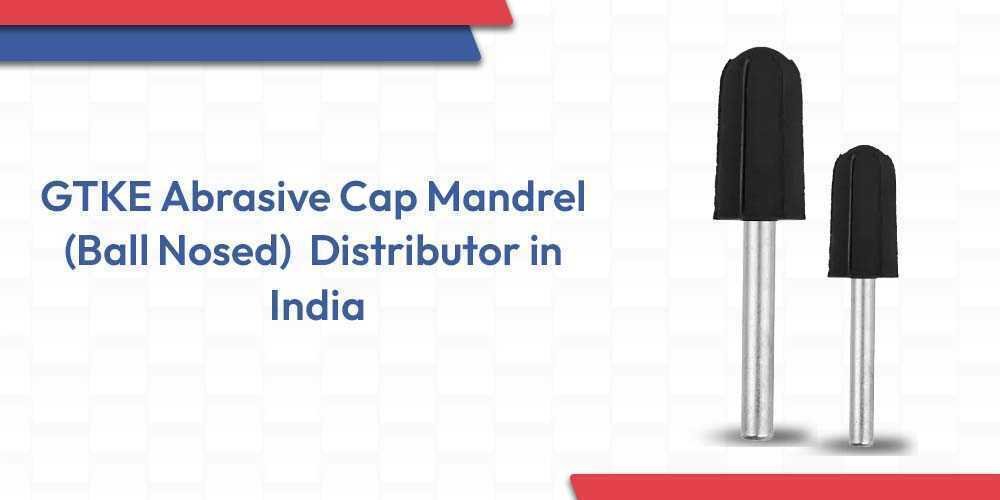
GTKE Abrasive Cap Mandrel (Ball Nosed) Distributor in India
Summary
If your shop needs precise radius finishing in hard-to-reach areas, the GTKE Abrasive Cap Mandrel with a ball-nosed profile delivers consistent surface quality, fast changeovers, and longer cap life. This guide explains what it is, where it fits in the finishing workflow, how to select the correct size and shank, recommended running parameters, and why buying from a reliable Indian distributor matters for uptime and cost per part.
Key Takeaways
- The GTKE Ball-Nosed Mandrel is a tool that allows for precise, controlled radius finishing on hard-to-reach areas, preventing gouging.
- Selecting the right mandrel involves matching the cap size to the job, picking a shank that fits your tool, and ensuring the nose radius is appropriate for the curve you are finishing.
- For optimal performance and longer cap life, it’s recommended to use lower RPMs with lighter, steady pressure, and to always keep the tool moving to avoid overheating.
- The document provides a troubleshooting guide to address common issues like chatter, cap slippage, and premature wear, helping operators quickly resolve problems.
- Choosing a reliable distributor like Supra Industries is crucial for maintaining consistent product availability, getting genuine parts, and accessing expert technical support.
What is a GTKE Abrasive Cap Mandrel (Ball Nosed)?
An abrasive cap mandrel is a reusable steel holder designed to securely grip small abrasive caps or sleeves. The ball-nosed geometry creates a gentle radius at the working end, allowing you to blend edges, remove burrs, and finish contours without gouging.
Key functions
- Holds abrasive caps firmly during high-speed rotary finishing
- Guides the operator along radii, fillets, and pockets
- Reduces chatter and improves consistency compared to freehand caps
Typical materials finished
- Mild steel, stainless steel, tool steel
- Aluminium and non-ferrous alloys
- Cast iron, hardened parts (light finishing)
- Plastics, composites, wood (where a controlled radius is needed)
Where the Ball-Nosed Mandrel Shines
- Deburring and edge rounding: Smooths sharp corners while maintaining design radius.
- Mould and die finishing: Polishes fillets and transitions in cavities and cores.
- Aerospace and medical: Improves surface quality in pockets and intricate geometries.
- Fabrication and weld shops: Blends weld toes and access corners without undercut.
Why choose a ball-nosed version over straight or cone shapes
- Forgiving at contact: The spherical lead prevents digging in.
- Better control on curves: Follows complex contours naturally.
- Clean blend lines: Minimises flats and witness marks along radiused edges.
What to look for in a quality GTKE mandrel
- Concentricity and low runout: Helps the cap cut evenly and last longer.
- Heat-treated tool steel: Resists wear at the expansion slots and nose.
- Secure expansion mechanism: Positive grip prevents cap slippage at speed.
- True nose radius: A consistent ball-nose profile yields repeatable finishes.
- Balanced shank: Reduces vibration and operator fatigue.
Selecting the Right Mandrel
1) Match cap size to the job
Choose your abrasive cap diameter and length based on the smallest radius, pocket size, and removal rate required. Ball-nosed mandrels are commonly paired with small-diameter caps that fit into tight spaces.
Common cap diameters: 5 mm, 6 mm, 8 mm, 10 mm, 12 mm, 16 mm
Typical grits: 4080 (heavy stock removal), 120180 (blending), 240400 (pre-polish)
Tip: For narrow pockets or tight radii, start with a smaller cap and lighter pressure to check fit, then step up if removal is too slow.
2) Choose shank diameter for your tool
- 3 mm or 1/8 in shank: Pencil grinders, flexible shafts, and light die grinders.
- 6 mm or 1/4 in shank: Standard die grinders and robust spindles for higher torque.
3) Pick a nose radius that fits your feature
Ball-nosed profiles are designed to track along a curve. As a rule, the mandrel nose should be smaller than or equal to the internal radius you are finishing. If the nose is too large, it will bridge the curve and flatten the blend.
4) Backing geometry and access
Consider overall length, necked-down sections for reach, and clearance in fixtures. A slightly longer reach helps in deep pockets but watch for deflection and vibration at high rpm.
Recommended Running Parameters
Every shop, cap brand, and material behaves slightly differently, but these practical ranges are a proven starting point:
- 3 mm shank with small caps (510 mm): 18,00030,000 rpm
- 6 mm shank with medium caps (1016 mm): 10,00020,000 rpm
- Feed & pressure: Light, steady contact; let the abrasive cut. Excess pressure overheats the cap and rounds the edge too aggressively.
- Pass strategy: Short, overlapping strokes around the radius. Keep moving to avoid heat spots.
Always follow the machine and consumable manufacturer’s maximum rpm ratings. Stop immediately if you feel chatter or see cap creep.
Troubleshooting Quick Guide
| Symptom | Likely Cause | Fix |
| Chatter or ripple finish | Excess rpm, poor concentricity, long overhang | Reduce rpm, shorten stick-out, verify collet and mandrel straightness |
| Cap slippage | Worn expansion slots or oily cap interior | Clean mandrel and cap, replace worn mandrel, seat cap fully |
| Premature cap wear | Too much pressure or wrong grit | Use coarser grit for stock removal, lighten pressure |
| Burn marks | Heat buildup from slow feed or high rpm | Keep the tool moving, reduce rpm, add brief dwell breaks |
| Flat spots on radius | Nose too large or angle too steep | Use smaller ball-nose size, approach tangent to the curve |
Example Specifications (reference guide)
These specs illustrate common options. Confirm the exact dimensions, tolerances, and rpm for the GTKE model you are purchasing.
| Model | Cap Ø Range | Nose Type | Shank Ø | Overall Length | Typical Max RPM |
| GTKE-BN-05 | 56 mm | Ball-nose | 3 mm | 4050 mm | 25,00030,000 |
| GTKE-BN-08 | 810 mm | Ball-nose | 3 mm or 6 mm | 4555 mm | 18,00025,000 |
| GTKE-BN-12 | 1012 mm | Ball-nose | 6 mm | 5060 mm | 12,00018,000 |
| GTKE-BN-16 | 1416 mm | Ball-nose | 6 mm | 5565 mm | 10,00015,000 |
Need a different reach, neck, or radius size? Ask for a custom configuration or alternative geometry.
Process Playbook: From Burr to Blend
- Identify the edge or pocket. Measure the smallest internal radius and depth.
- Pick the cap and mandrel. Start with a cap that fits freely into the smallest area.
- Set rpm and grip. Load the cap fully onto the mandrel, check runout, set rpm in the safe range.
- Light contact first. Feather the edge. Do not dwell.
- Blend the radius. Track around the curve with short strokes.
- Step down in grit. Move from removal to blend to pre-polish.
- Final checks. Inspect the surface under consistent lighting. No flats or gouges should be visible.
Safety Notes You Should Not Skip
- Wear eye protection, gloves, and hearing protection.
- Inspect mandrels for wear, cracks, or bent shanks before use.
- Use the correct collet size and ensure full shank engagement.
- Never exceed the lowest rated rpm among machine, mandrel, and cap.
- Keep the work area clean; loose swarf can catch the rotating cap.
Industries and Use Cases
Metal fabrication and MRO
- Edge rounding on brackets, housings, and laser-cut parts
- Blend weld toes in tight corners before painting or coating
Tooling and die shops
- Finishing fillets and radius transitions after EDM and milling
- Removing micro burrs without altering geometry
Automotive and aerospace
- Deburring small internal features where consistency and traceability matter
Medical devices and instruments
- Clean radius transitions on handles and small assembly components
Furniture and wood-metal hybrid
- Gentle radius blends on fixtures and decorative hardware
Why Your Distributor Choice Impacts Cost Per Part
Consistent availability
Downtime is expensive. A distributor who holds stock of popular GTKE ball-nosed mandrels and matching abrasive caps helps you avoid line stops.
Traceability and genuine supply
Genuine parts ensure the nose radius and expansion mechanism perform as expected across batches.
Technical support
Experienced application support shortens trial-and-error time. Correct rpm, cap selection, and shank choice can double cap life.
Commercial flexibility
Bulk pricing, scheduled deliveries, and GST-ready invoices keep procurement simple and predictable.
Why Buy From Supra Industries
- Focused on finishing tools: Practical guidance on mandrel geometry, cap pairing, and rpm selection.
- Reliable availability: Stock planning for popular diameters and shanks.
- Pan-India service: Dispatch to major manufacturing hubs with responsive after-sales support.
- Custom and special requests: Assistance with non-standard reach, nose radius, or shank options.
- Procurement friendly: Quotations, GST invoices, and bulk programs on request.
Looking to standardise a finishing cell across multiple lines? Ask for a bundle quote that includes caps, mandrels, and trial packs by grit.
FAQ
Q1. What is the main benefit of a ball-nosed mandrel?
It follows curves smoothly and reduces the chance of gouging on edges and fillets.
Q2. Which shank should I pick, 3 mm or 6 mm?
Use 3 mm for pencil grinders and light access work. Use 6 mm for higher torque die grinders and larger caps.
Q3. How do I prevent cap slippage?
Clean both the cap and mandrel, ensure the cap is seated fully, and replace worn mandrels with loose expansion slots.
Q4. What rpm should I start with?
Begin at the lower half of the safe range for your cap size and shank, then increase until cutting stabilises without heat.
Q5. Can I finish stainless and aluminium with the same setup?
Yes, but you may need different grits. Use controlled pressure on aluminium to avoid loading, and dress or change caps as needed.
Q6. How do I avoid flat spots on a radius?
Use a ball-nose smaller than the target radius and keep the tool moving with light, even passes.
Q7. Do I need lubrication or coolant?
For metals, a light mist can control heat on aggressive passes. Follow your shop’s process rules.
Q8. When should I replace the mandrel?
Replace if you see uneven nose wear, bent shanks, or if caps no longer grip securely.
Q9. Are there alternatives to ball-nosed mandrels?
Yes. Straight, tapered, or cone-shaped holders are used for flats, chamfers, or different access needs.
Q10. Can I standardise on a small set of sizes?
Most shops work well with two or three cap diameters and both 3 mm and 6 mm shanks to cover typical jobs.
About Supra Industries
Supra Industries supports manufacturers with dependable finishing and fabrication consumables. The focus is practical: improve finish quality, cut cycle time, and keep lines running. For help selecting the correct ball-nosed mandrel and abrasive caps for your parts, contact our technical team with your drawings or photos.