
Industrial Guide to Choosing the Right Deburring Tool & Wheel for Metal Parts
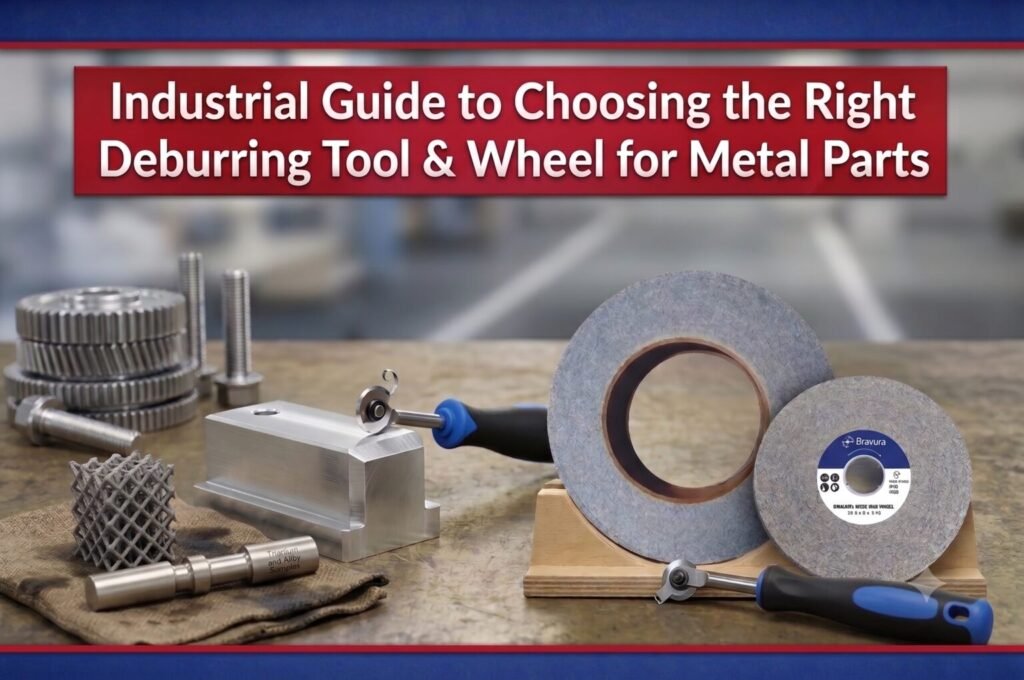
In precision metal fabrication, manufacturing automotive components, or aerospace engineering, leaving sharp burrs on machined edges is not an option. It ruins component fits, creates safety hazards, and causes structural failures. Selecting the exact deburring wheel dictates your floor’s efficiency, directly impacting operational lifespan, surface integrity, and labor costs. Failing to manage secondary burr accumulation below critical thermal degradation thresholds leading up to 180 degree centigrade risks substrate smearing and structural rejection.
Key Takeaways for Industrial Stakeholders
- For CEOs & CFOs: Upgrading from low-tier abrasives to dynamically balanced deburring wheels lowers the total cost of ownership (TCO) by reducing machine downtime and cutting per-part finishing costs.
- For Procurement Officers & Wholesale Buyers: Securing bulk orders of ISO 9001:2015-certified non-woven media guarantees reliable volume tier pricing, stable lead times, and strict batch compliance.
- For Plant Managers & Product Engineers: Matching proper tool durometer ratings and rotational speed tolerances (RPM limits) to the severity of the burr eliminates edge deformation and enhances floor safety metrics.
B2B Deburring Efficiency & Component Matrix
| Technical Threshold | Low-Tier Non-Woven Alternatives | Supra Premium Deburring Standards |
| Substrate Adhesion Dynamics | High smear transfer; resin breakdown above 180 degree centigrade | Smear-free, heat-resistant chemistry holding strict geometry |
| Dynamic Balance Calibration | High vibrational harmonics causing operator fatigue | Precision-molded core preventing concentricity failure |
| Tensile Shear Strength | Rapid edge fraying when processing sharp stamping burrs | High-density fiber cross-bonding built for severe edges |
| Operational Lifespan | 1X Baseline (Frequent manual wheel dress cycles) | 2X to 3X Extended Lifespan via advanced grain density |
| Procurement Risk | High batch inconsistency; volatile stock delivery rates | Pune-manufactured, fully traceable industrial wholesale supply |
Convolute Wheels vs. Unitized Wheels: What’s the Difference?
Understanding the structural differences between these two non-woven powerhouses is critical before allocating capital to automated lines or manual stations. Both utilize an open nylon web structure embedded with abrasive grains, but their distinct manufacturing methods alter their mechanical behavior under pressure.
- Convolute Wheels: Formed by wrapping non-woven abrasive material around a central core. They must always run in a single direction (indicated by an arrow) and are unmatched for heavy-duty, high-efficiency automatic machinery deburring. The wrapping process gives them excellent edge durability and structural consistency across wide cylindrical surfaces.
- Unitized Wheels: Formed by compressing layers of non-woven web together. They are bidirectional and excellent for small, intricate parts where precision tolerances must be held. Because they lack a wrapped directional bias, they perform consistently when used on manual bench grinders, portable die grinders, or when moving parts multidirectionally across the face of the wheel.
Selecting the Wheel for Your Specific Deburring Severity
For Heavy-Duty Burrs & Edge Radiusing
Heavy stamping burrs, primary primary casting flash, and thick laser-cut slags demand an aggressive grain wear profile that resists tearing. For these applications, highlight the smear-free, heat-resistant performance of specialized options like the DEX Deburr Convolute Wheel or EXU Unitized Wheel.
These configurations feature high structural density designed to withstand high operational pressures. They rapidly generate a clean radius edge without loading or shedding resin onto the workpiece, keeping the metal cool and below critical heat thresholds.
For Light Deburring & Precision Polishing
When handling machined threads, high-value electronics housings, or delicate medical instruments, aggressive metal removal will ruin the part. Detail how to hold critical tolerances on sensitive components using a light-pressure setup like the LDP Convolute Wheel.
The LDP profile provides subtle conformability, absorbing operators’ manual errors and clearing fine micro-burrs while maintaining the component’s exact dimensional specifications.
Struggling with Smearing or Tool Wear on Your Deburring Line?
Supra Industries manufactures premium, high-tensile abrasive solutions directly out of our Pune facility to eliminate manufacturing bottlenecks. Fill out our Bulk Order & Inquiry Form to sync with an applications engineer and find the perfect density wheel for your metal alloy.
Reaching Internal Channels and Contours
What happens when the burr is hidden inside a pipe, cylinder, or complex casting recess? Standard flat-surface wheels cannot reach it because their rigid side profiles risk structural gouging. Forcing a large wheel into a tight radius alters the target geometry and triggers catastrophic tool wear.
To solve this internal finish challenge, introduce industrial spindle mops designed for high-speed internal cleaning and smooth blending of tight contours. Engineered with an integral steel spindle and high tensile strength, these mops enter tight internal diameters safely, expanding under centrifugal force to clean internal channels uniformly without altering critical engine block or valve tolerances.
Struggling with Smearing or Tool Wear on Your Deburring Line?
Supra Industries manufactures premium, high-tensile abrasive solutions directly out of our Pune facility to eliminate manufacturing bottlenecks. Fill out our Bulk Order & Inquiry Form to sync with an applications engineer and find the perfect density wheel for your metal alloy.