
Lukas Cutting & Grinding Discs: Choosing the Right Disc for Metal
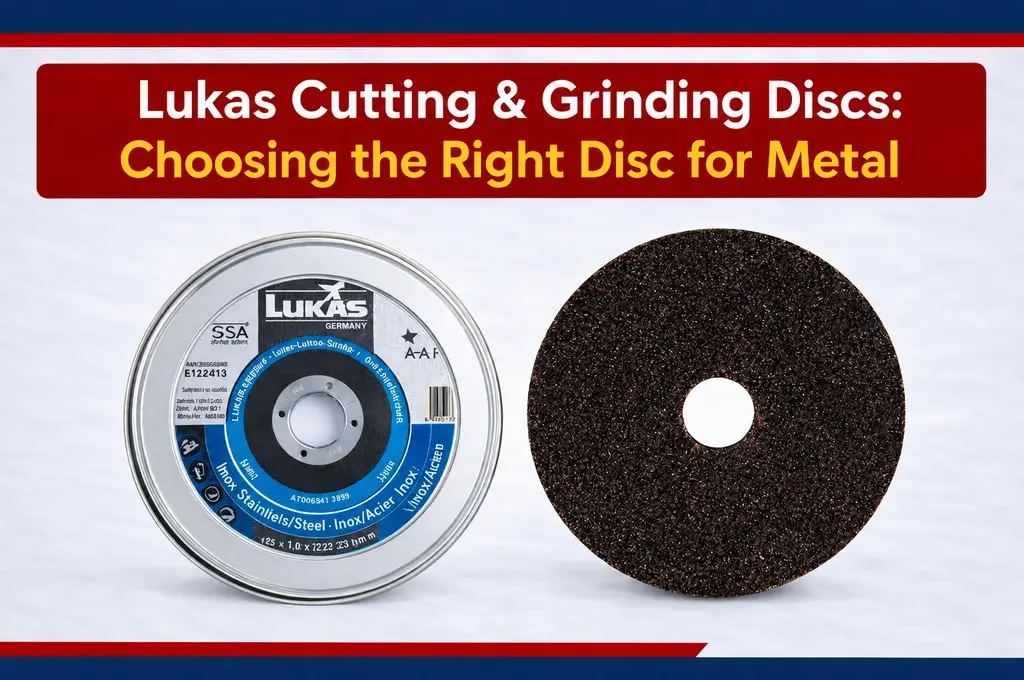
Selecting the correct LUKAS cutting and grinding disc requires matching grain crystallography (Ceramic, Zirconia, or Aluminum Oxide) and bond hardness (Grades N through S) to alloy tensile strength, ensuring peripheral speeds remain between 80 m/s and 100 m/s for maximum material removal rate (Qw) with zero grain glazing. For industrial fabrication, deploying discs formulated with iron-, sulfur-, and chlorine-free resins (<= 0.1% Fe/S/Cl) prevents intergranular stress corrosion and metallurgical heat-tint on 304/316L stainless steel and titanium substrates.
Key Takeaways for Industrial Stakeholders
- For CFOs & Procurement Directors: Utilizing high-density, multi-layer reinforced LUKAS cutting discs reduces wheel consumption ratios by up to 38% per 1,000 cuts, directly lowering consumable expenditure and bulk freight overhead.
- For Plant Managers & Production Engineers: Dynamic runout calibration (<= 0.05 mm) and vibration-damping fiberglass cores lower operator hand-arm vibration (HAV) exposure below 2.5 m/s^2 while eliminating edge-chipping during high-load weld gouging.
Technical Specification & TCO Comparison Matrix
| Technical Metric | Standard / Low-Tier Commercial Cut-Off Discs | LUKAS Engineered Cutting & Grinding Discs (Supra Portfolio) | Operational & Financial Impact |
| Bonding Matrix Architecture | Standard phenolic resin; basic chopped fiberglass reinforcement | Cross-linked, thermally stabilized thermosetting resin with dual high-tensile fiberglass meshes | Tool Life: Delivers 2.5x more cuts per disc before reaching discarded stub diameter. |
| Dynamic Balance & Concentricity | High dynamic runout (> 0.25 mm); uneven mass distribution | Precision dynamically balanced (<=0.05 mm runout) | Safety & Machine Life: Protects angle grinder spindle bearings and eliminates vibration-induced micro-fractures. |
| Contamination Threshold (Fe, S, Cl) | Uncertified (> 0.5% iron/sulfur impurities) | Certified <= 0.1% Fe/S/Cl content (oSa and EN 12413 compliant) | Regulatory Risk: Eliminates pitting and rogue rust on nuclear, aerospace, and pharmaceutical stainless piping. |
| Thermal Degradation Point | Rapid bond softening and disc glazing at > 125 degree C. | Thermally resilient bond maintaining micro-fracturing up to 200 degree C. | Scrap Rate: Prevents heat-affected zone (HAZ) annealing and edge burnishing on hard alloys. |
| Stock Removal Efficiency (Qw) | 12 – 18 g/min under standard manual pressure | 32 – 48 g/min with self-sharpening micro-crystalline ceramic grains | Labor Cost: Cuts metal severance and weld grinding cycle times by up to 45%. |
What Are LUKAS Cutting & Grinding Discs? Material Architecture & Bond Telemetry
LUKAS bonded abrasives are precision-engineered cutting and stock-removal tools manufactured in compliance with strict EN 12413 and oSa (Organization for the Safety of Abrasives) safety parameters. Their structural integrity relies on the balance between abrasive crystal toughness, bond matrix hardness, and internal textile reinforcement.
+————————————————————————-+
| BONDED DISC CROSS-SECTION ARCHITECTURE |
| |
| [====================================] Outer Fiberglass Mesh Reinforce |
| [ * * * * * * * * * * * * ] Abrasive Grains (Ceramic/AlOx) |
| [————————————] Phenolic Resin + Active Fillers |
| [====================================] Center Fiberglass Mesh Core|
| [ * * * * * * * * * * * * ] Abrasive Grain & Matrix Layer |
| [====================================] Base Fiberglass Mesh Layer |
| || || |
| || Steel Bushing || [Clamping Bore / Dynamic Hub] |
+————————————————————————-+
1. The Multi-Layer Fiberglass Matrix
The mechanical backbone of each disc consists of high-tensile woven fiberglass netting impregnated with synthetic resins. This structural scaffold provides the tensile shear strength required to withstand centrifugal burst forces exceeding 150 m/s and resists side-load lateral stresses during aggressive handheld angle grinding.
2. Phenolic Resin Bonds & Active Grinding Fillers
The abrasive minerals are locked in place by heat-cured thermosetting phenolic resins enriched with active chemical fillers (such as cryolite and fluoroborates). These fillers melt under the extreme contact temperatures of the cut, creating an internal lubricant that reduces frictional heat and cools the contact zone to prevent workpiece burnishing.
Thin Cutting Wheels vs. Heavy Grinding Discs: Selecting the Right Geometry
Specifying the wrong disc thickness or geometric profile creates safety hazards, increases kerf loss, and drives up energy consumption on high-amperage pneumatic and electric tools.
TYPE 41: FLAT CUT-OFF DISC TYPE 42 / 27: DEPRESSED CENTER DISC
(Thickness: 0.8mm – 1.9mm) (Thickness: 2.0mm – 7.0mm)
=================================== =========== ===========
=================================== \ /
[Kerf Cut] \__________/
[Deep Parting, Pipe & Sheet Cutting] [Weld Seam Gouging & Heavy Stock]
Thin Cut-Off Discs (Type 41 / Type 42, 0.8 mm to 1.6 mm)
- Primary Objective: High-speed metal parting, sheet metal trimming, pipe severance, and precision slicing.
- Kerf Telemetry: Ultra-thin 1.0 mm geometries minimize contact area, reducing cutting resistance and motor load while preventing broad heat-affected zones (HAZ).
- Operational Safety Rule: Strictly engineered for 90 degree perpendicular penetration; never subject a thin Type 41 cut-off wheel to lateral or side-grinding pressure.
Depressed Center Grinding Discs (Type 27, 6.0 mm to 7.0 mm)
- Primary Objective: Heavy weld seam removal, edge chamfering, root-pass pipeline grinding, and foundry casting gate dressing.
- Structural Rigidity: Triple-layer fiberglass reinforcement allows aggressive stock removal at working angles between 20 degree and 35 degree without risk of wheel delamination.
Grain Crystallography: Matching Minerals to Substrate Metallurgy
Matching the mineral’s micro-fracturing properties to the tensile strength and thermal conductivity of the metal prevents grain pull-out and surface glazing.
+————————————————————————-+
| METALLURGICAL GRAIN SELECTION MATRIX |
+—————————–+——————–+———————-+
| WORKPIECE MATERIAL | GRAIN CHEMISTRY | BOND SPECIFICATION |
+—————————–+——————–+———————-+
| Carbon Steel / Structural | Aluminum Oxide | A 30 S-BF (Hard) |
| 304 / 316L Stainless Steel | Ceramic / Zirconia | ZA 46 T-BF (Inox) |
| Titanium / Inconel Alloys | Micro-Crystalline | CER 36 R-BF (Cool) |
| Cast Iron / Ductile Iron | Silicon Carbide/AO | AC 24 R-BF (Heavy) |
| Aluminum & Non-Ferrous | Stearated AlOx | A 36 N-BF (Anti-Load)|
+—————————–+——————–+———————-+
1. Micro-Crystalline Ceramic (Next-Gen High-Yield Production)
Ceramic grains feature a uniform crystalline microstructure that micro-fractures under high radial loads to continuously generate fresh cutting edges.
- Application Scope: High-volume weld removal on hardened armor plate, structural Inconel, and duplex stainless steels.
- Efficiency Metric: Multiplies stock removal rates by up to 3x compared to standard aluminum oxide, remaining cool under intense friction.
2. Zirconia Alumina (High-Pressure Heavy Fabrication)
Zirconia alumina delivers extreme grain toughness and thermal shock resistance.
- Application Scope: Heavy fabrication shops working on structural I-beams, ship hull plates, and cast steel gating.
- Pressure Dynamics: Requires medium-to-high grinding pressure (> 40 N) to trigger self-sharpening; under light pressure, the grain can glaze over.
3. Specialty INOX / Non-Ferrous Formulations
- Stainless Steel (INOX): Manufactured without iron, sulfur, or chlorine fillers to prevent galvanic corrosion and pitting.
- Aluminum & Soft Metals: Specially bonded with open pore structures and anti-friction additives to prevent melted swarf from packing the wheel pores (clogging/loading).
Operational Safety, Dynamic Telemetry, and Failure Analysis
Safe operation requires running within strict peripheral surface speed limits and adhering to dynamic balance standards.
+———————————————————————–+
| OPERATING SPEED & TELEMETRY BOUNDARIES |
| |
| Standard Peripheral Velocity: 80 m/s (Standard Angle Grinders) |
| High-Performance Heavy Velocity: 100 m/s (High-Frequency / Petrol) |
| Maximum Dynamic Runout: <= 0.05 mm |
| Maximum Clamping Flange Runout: <= 0.02 mm |
| [CRITICAL SAFETY: Discard any disc dropped or exposed to dampness] |
+———————————————————————–+
Real-World Failure Modes & Corrective Action Telemetry
- Failure: Disc Glazing & Workpiece Blueing (Thermal Discoloration)
- Root Cause: Bond hardness is too high for the alloy; grain rounded without fracturing; insufficient grinding pressure applied.
- Corrective Action: Switch to a softer bond grade (e.g., from grade ‘S’ down to ‘P’ or ‘Q’); verify that tool peripheral speed is maintained at >=70 m/s.
- Failure: Peripheral Edge Fraying & Spalling
- Root Cause: Workpiece slipping in clamp; excessive twisting or angling during deep slotting cuts; worn grinder spindle bearings causing runout harmonics.
- Corrective Action: Ensure rigid mechanical work-holding; maintain strict $90^\circ$ perpendicular tracking; inspect drive spindle runout (< 0.03 mm).
- Failure: High Vibration & Operator Fatigue
- Root Cause: Asymmetrical wheel clamping; worn, non-parallel mounting flanges; unequal flange diameters.
- Corrective Action: Inspect mounting flanges according to EN 12413 standards (flange diameter must equal at least 1/3 of the wheel diameter).
Wholesale Procurement, Supply Chain Stability & Engineering Support
Supra Industries is an authorized industrial distributor and solutions provider for the complete LUKAS abrasive line, delivering direct technical auditing, inventory standardization, and volume-tier wholesale supply.
B2B Supply Capabilities:
- SKU Consolidation Audits: Engineering reviews of plant consumable usage to replace low-yield commodity discs with optimized LUKAS grains, cutting total consumable inventory by up to 30%.
- Volume Tiered B2B Contracts: Reliable bulk container and pallet supply lines, customized delivery scheduling, and lot-tracked safety certifications for QA audits.
- Automated & Robotic Finishing Support: Technical consultation for integrating LUKAS cutting and grinding tools into CNC stations and robotic weld-dressing cells.
Request a Plant Application Audit or Bulk Quotation
Improve cutting speeds, protect operator safety, and reduce your cost-per-cut:
- Browse the Full Supra Industries Industrial Abrasives Catalog
- Engineering Consultation: Contact Our Industrial Technical Team for on-site cycle-time benchmarking, wheel hardness optimization, and alloy compatibility reviews.
- Direct Commercial Inquiries: Connect with our wholesale procurement division for bulk tiered price sheets, safety data compliance packets, and free sample qualification kits.