
The Ultimate Deburring Convolute Wheel Selection Guide: Matching Density & Grade to Your Metal Type
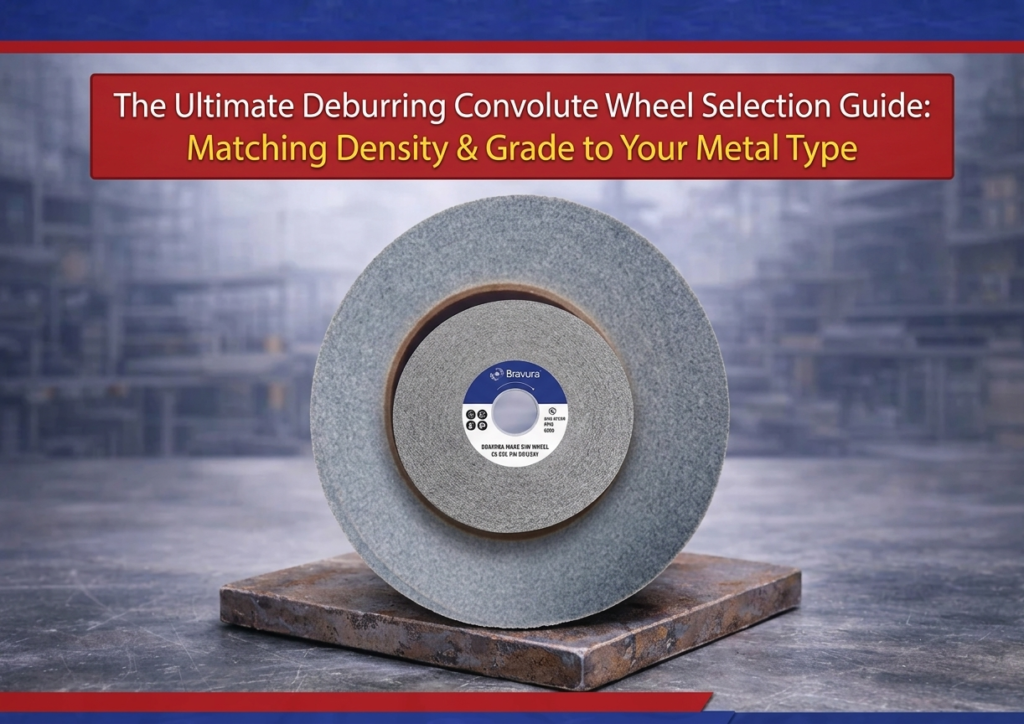
Deburring convolute wheels deliver optimal edge radius consistency and burr removal when selected using a structured matrix matching wheel density (soft 5 to hard 9) and mineral grain grade (fine to coarse) directly to the yield strength, thermal conductivity, and hardness of the target alloy. Selecting the correct density and grain combination prevents substrate smearing, eliminates chatter-induced micro-fractures, and lowers cost-per-part in automated and manual metal finishing operations.
Key Takeaways for Industrial Stakeholders
- [For CFOs/Buyers]: Specifying precise convolute density and grade reduces abrasive wheel changeover frequency by up to 35%, lowering annual consumable spend and minimizing bulk procurement lead-time risks.
- [For Plant/Product Managers]: Matching grain friability and dynamic density to metal yield strength eliminates thermal distortion, preserves strict dimensional tolerances (±0.001 in), and reduces rework rates on high-value aerospace and surgical components.
Convolute Deburring Performance Matrix: Standard vs. Supra Premium
| Performance Metric | Standard/Low-Tier Non-Woven Wheel | Supra Premium Convolute Wheel | Operational & Financial Impact |
| Technical Threshold | Inconsistent web density; resin degradation at $>140^\circ\text{C}$ | Uniform web construction; thermal threshold $>210^\circ\text{C}$ | Prevents substrate smearing and resin transfer onto reactive metals. |
| Operational Lifespan | Rapid edge shedding; low resistance to high burr loads | High unit density; controlled grain shedding via cross-linked binders | Extends wheel life 2.5x to 4x under continuous industrial duty cycles. |
| TCO Impact | High total cost due to frequent downtime and part rework | Optimized cost-per-finish; predictable wear profiles | Reduces direct labor cost per finished unit by 18–25%. |
| Procurement Risk | Uncertified grain purity; variable batch-to-batch hardness | ISO 9001:2015 batch calibration; traceable raw materials | Eliminates process drift and incoming quality control (IQC) failures. |
1. Material Science of Convolute Deburring Wheels
Convolute wheels are manufactured by wrapping non-woven synthetic fibers—impregnated with abrasive grains and resin binders—around a rigid central core. Unlike unitized construction, which is compressed into flat block layers, the directional wrap of a convolute wheel provides high radial strength, rotational balance, and consistent deburring force over its operational life.
The Three Core Variables
Deburring effectiveness is dictated by three structural properties:
- Fiber Denier & Openness: The non-woven nylon web structure cushions mechanical shock and allows airflow, keeping contact zones cool during continuous operation.
- Resin System: Advanced polyurethane or phenolic resin coatings lock grains into position, maintaining structural integrity across high centrifugal forces.
- Grain Profile & Friability: Sharp abrasive grains fracture controlledly under friction, continually exposing clean, sharp cutting edges throughout the wheel’s lifespan.
Operational Mandate: Convolute wheels are unidirectional. Always mount the wheel with the arrow on the side flange pointing in the direction of spindle rotation. Reversing rotation can unravel the convolute layers and lead to wheel failure.
2. Structural Density and Grain Grade Mechanics
Matching wheel density and abrasive grain grade to your target material ensures controlled stock removal without damaging part geometry.
Density Scale (5 to 9)
- Density 5 & 6 (Soft to Medium-Soft): Highly conformable. Ideal for intricate geometries, low contact pressures, and applications where changing edge radii is strictly prohibited.
- Density 7 & 8 (Medium-Hard to Hard): High edge durability. Designed for heavy burr removal on flat edges, stamped metal parts, and automated robot cell finishing.
- Density 9 (Extra Hard): Maximum density and rigidity. Engineered for severe edge break applications, heavy primary burrs, and high-pressure gear deburring.
Abrasive Mineral Selection
- Silicon Carbide (SiC): A sharp, brittle mineral with a high fracture rate. Best suited for non-ferrous metals (aluminum, brass, copper), titanium, and stainless steel finishing applications requiring bright aesthetic finishes.
- Aluminum Oxide (AO): A tough, wedge-shaped grain resistant to fracturing under heavy mechanical stress. Best suited for carbon steel, high-tensile alloys, and heavy-duty deburring requiring high cut rates.
3. Material-Specific Selection Matrix
Using the wrong wheel combination can lead to surface contamination, excessive wheel wear, or thermal stress on the workpiece. Use this selection framework for key metal categories:
Aluminum and Soft Non-Ferrous Alloys
- Challenges: Low melting points cause soft metals to weld onto abrasive grains, clogging the wheel face.
- Optimization: Use open-web Density 6 or 7 wheels paired with Silicon Carbide (Medium grade). The higher friability of SiC breaks down web fibers evenly, ejecting soft debris before loading occurs.
Stainless Steel (300 & 400 Series)
- Challenges: High work-hardening rates require controlled deburring force to prevent localized stress hardening and heat discoloration.
- Optimization: Deploy Density 7 or 8 Aluminum Oxide wheels (Medium or Fine grade). The tough AO grain resists fracturing against high-tensile edges while maintaining consistent edge-break geometries.
Titanium and Inconel Superalloys
- Challenges: Poor thermal conductivity concentrates heat at the tool-part interface, risking micro-cracking or grain boundary degradation.
- Optimization: Select Density 5 or 6 Silicon Carbide (Fine or Very Fine grade) wheels. Operating at lowered peripheral speeds ($20\text{–}25\text{ m/s}$) prevents heat build-up while producing precise, burr-free chamfers.
Carbon Steel & Cast Iron
- Challenges: Heavy primary burrs require high force without breaking down the wheel’s edge profile.
- Optimization: Implement Density 8 or 9 Aluminum Oxide wheels (Coarse or Medium grade) for high wear resistance and consistent heavy burr removal across automated production lines.
4. Operating Parameters & Process Optimization
Maximizing the operational lifespan and finish performance of convolute deburring wheels requires strict adherence to mechanical speed and pressure parameters.
Surface Speed Engineering (SFPM)
Convolute performance depends on Surface Feet Per Minute (SFPM). Calculate SFPM using this standard formula:
- Excessive Speed ($>8,500\text{ SFPM}$): Hardens the wheel action, increases frictional heat, and risks resin smearing onto the workpiece surface.
- Deficient Speed ($<3,000\text{ SFPM}$): Causes the wheel to bounce across edges, tearing the non-woven web structure and leading to premature wheel wear.
Contact Pressure Guidelines
- Apply light to medium pressure ($1.5\text{–}3.5\text{ kg/cm}^2$). Let the abrasive grains perform the cutting action.
- Heavy pressure distorts the wheel face, increases part temperature, and accelerates wheel breakdown without improving cut rate.
- Integrated automated systems should monitor current draw ($A$) on spindle motors to maintain constant contact pressure as the wheel diameter wears down.
5. Troubleshooting Industrial Deburring Defects
1. Resin Smearing & Surface Discoloration
- Root Cause: Excessive frictional heat causing phenolic/polyurethane binder breakdown on the substrate.
- Correction: Reduce spindle speed by 15–20%, check directional rotation, or decrease applied mechanical pressure. Switch to a softer density (e.g., Density 7 to Density 6) for improved airflow.
2. Excessive Wheel Wear or Edge Shedding
- Root Cause: Operating below recommended SFPM or using a wheel density too soft for sharp, heavy primary burrs.
- Correction: Increase spindle speed to optimal SFPM ranges. Upgrade from a Density 6 wheel to a Density 8 wheel with hard-formulated resin systems.
3. Surface Chatter Marks & Geometry Distortion
- Root Cause: Dynamic imbalance, bent spindle arbors, or excessive contact pressure forcing the wheel out of round.
- Correction: Truing and dressing the wheel using a mechanical dressing bar. Verify dynamic balance calibration and check spindle runout specifications ($<0.02\text{ mm}$).
Partner with Supra Industries for Custom Surface Finishing Solutions
Optimizing deburring operations requires high-performance abrasives and tailored application engineering. Supra Industries manufactures premium non-woven convolute wheels engineered to strict ISO 9001:2015 quality standards.
Whether you need to streamline high-volume production lines, reduce total cost of ownership (TCO), or select custom abrasive setups for specialized alloys, our technical specialists are ready to help.
- Explore our complete product line in the Supra Industries Wholesale Catalog.
- Contact our engineering team for custom sizes, technical support, or bulk procurement pricing.
- Request a tailored operational audit via our Commercial Quote Request Pipeline.