
Prepping Stainless Steel for Mirror Finish with Light Polishing Convolute Wheel
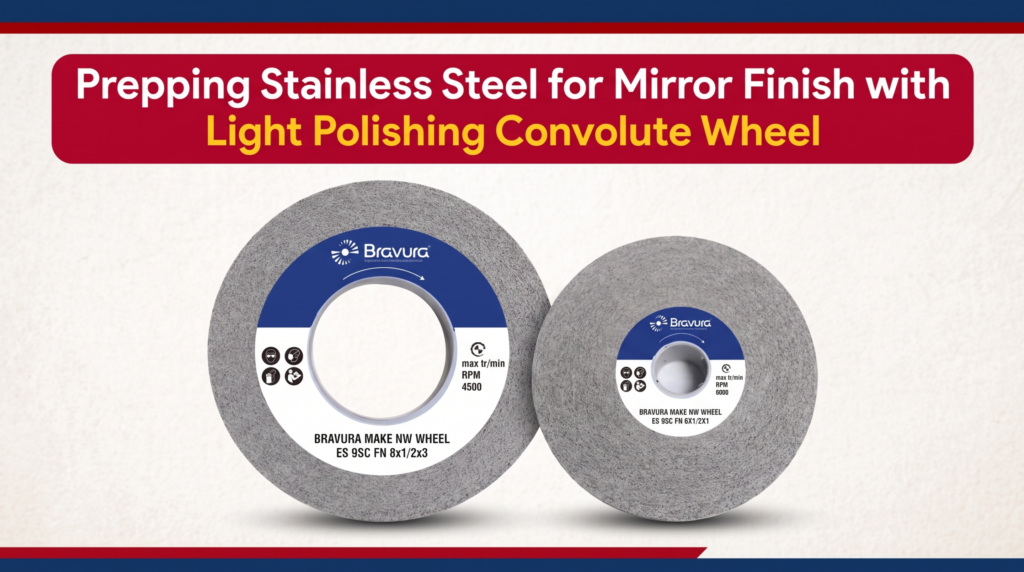
A Light Polishing Convolute Wheel (LP Series) prepares stainless steel for a final mirror buff by using a spiral-wound, non-woven synthetic fiber web impregnated with superfine Silicon Carbide (MFN, VFN, SFN, UFN) abrasive grains to refine surface roughness below Ra $0.15\,\mu\text{m}$ without generating frictional heat. This compliant, open-web matrix eliminates micro-scratches, swirl marks, and abrasive haze left by standard finishing belts, producing a dark-shining, scratch-free substrate that cuts downstream cotton-mop buffing time and compound consumption by up to 40%.
Key Takeaways for Industrial Stakeholders
- [For CFOs & Wholesale Buyers]: Integrating Bravura™ Light Polishing Convolute Wheels prior to final buffing reduces abrasive buffing compound usage by up to 40%, compresses multi-stage labor hours, and lowers total cost-per-part across high-volume automotive and architectural runs.
- [For Plant Managers & Process Engineers]: Calibrated VFN, SFN, and UFN Silicon Carbide formulations hold consistent pre-mirror Ra thresholds ($0.08\,\mu\text{m}$ to $0.18\,\mu\text{m}$) on AISI 304/316 stainless steel while maintaining interface temperatures below $150^\circ\text{C}$ to prevent resin smearing and chromium-oxide heat tint.
Performance & Cost Comparison Matrix: Pre-Mirror Surface Conditioning
| Evaluation Parameter | Industry Standard / Low-Tier Polishing Wheel | Supra Industries Bravura™ Light Polishing Convolute Wheel |
| Technical Threshold | Uncalibrated fiber density with inconsistent grain dispersion; leaves residual micro-scratches ($R_a > 0.25\,\mu\text{m}$) and smears resin above $140^\circ\text{C}$. | Precision-wound non-woven matrix in MFN, VFN, SFN, and UFN grades delivering uniform, dark-shining Ra $0.08\,\mu\text{m} – 0.18\,\mu\text{m}$ conditioning with dynamic balance calibration. |
| Operational Lifespan | Rapid face glazing and edge fraying after 25–40 linear meters of stainless steel conditioning, forcing frequent manual wheel dressing. | Self-refreshing spiral fiber attrition provides 35%–45% longer service life with ultra-low dust generation and zero core delamination under lateral pressure. |
| TCO Impact | Escalates downstream buffing compound consumption, extends sisal/cotton mop dwell times, and increases rework rates from swirl marks. | Eliminates intermediate belt-sanding steps, cuts buffing compound waste by up to 40%, and reduces overall finishing cycle time per component. |
| Procurement Risk | High batch-to-batch Durometer variance, off-center arbor bores causing chatter marks, and unpredictable import lead times. | ISO 9001:2015 manufacturing standards, repeatable compression ratings, and direct wholesale supply from Supra Industries’ Pune–PCMC hub. |
Material Science: Why Pre-Mirror Conditioning Determines Buffing Efficiency
Attempting to transition directly from a standard 320-grit coated belt or medium deburring wheel to a cloth buffing mop with polishing compound is a primary source of rework in stainless steel fabrication. Cloth mops lack the structural rigidity to level deep directional scratch valleys; instead, they burnish the peaks of those scratches, creating a deceptive “false shine” that reveals micro-grooves under direct inspection lighting.
The Bravura™ Light Polishing Convolute Wheel bridges this metallurgical gap through a spiral-wound, three-dimensional non-woven architecture. By wrapping a fine-denier nylon fiber web saturated with flexible polyurethane/phenolic binders and superfine Silicon Carbide (SiC) grains around a rigid core, the wheel creates a cushioned, uniform cutting plane that erases directional belt lines while imparting a dense, dark-shining luster.
- Substrate Adhesion Dynamics: Elasticized resin binders anchor superfine Silicon Carbide particles evenly throughout the three-dimensional nylon web, preventing loose abrasive shedding that could contaminate the workpiece and cause deep random “wild scratches.”
- Grain Wear Profiles (Silicon Carbide vs. Aluminum Oxide): Superfine Silicon Carbide micro-fractures into razor-sharp, low-profile cutting points under minimal contact load, shearing austenitic stainless steel (AISI 304 and 316) cleanly without the work-hardening or metal smearing typical of dull Aluminum Oxide grains.
- Open-Web Thermal Dissipation: Continuous airflow through the porous convolute layers dissipates frictional heat rapidly, keeping surface temperatures well below the $180^\circ\text{C}$ thermal degradation threshold where binder resins liquefy and transfer onto the metal surface.
Grade Calibration (MFN, VFN, SFN, UFN) for Mirror-Prep Workflows
Achieving a distortion-free No. 8 mirror finish on automotive exhaust tips, decorative trim, surgical instruments, or sanitary dairy vessels requires stepping down surface roughness systematically. Selecting the exact grade within the Bravura™ Light Polishing Convolute Wheel lineup ensures complete removal of prior scratch patterns before final color buffing.
1. Progressive Grade Selection Matrix
- MFN (Medium Fine): Removes light belt scratches (240–320 grit) and minor handling scuffs on stamped stainless steel brackets, establishing a uniform satin-bright baseline (Ra $0.20\,\mu\text{m} – 0.28\,\mu\text{m}$).
- VFN (Very Fine): Refines satin surfaces into a smooth, low-haze pre-buff finish (Ra $0.14\,\mu\text{m} – 0.20\,\mu\text{m}$), eliminating 400-grit belt lines on curved tubular assemblies and architectural handrails.
- SFN (Super Fine): Produces a high-clarity, dark-shining luster (Ra $0.10\,\mu\text{m} – 0.14\,\mu\text{m}$) on stainless steel, brass, and aluminum components, reducing final cotton-mop buffing to a single quick pass.
- UFN (Ultra Fine): Delivers maximum cosmetic surface refinement ($R_a \le 0.08\,\mu\text{m}$) with virtually zero visible scratch pattern, engineered for optical-grade trim, pharmaceutical tanks, and precision medical housings.
2. Dimensional Configurations for Manual & Automated Cells
- Outer Diameters (6″, 8″, 12″, 14″): Compact 6” and 8” wheels provide precise operator control on bench motors and contoured automotive parts, while 12” and 14” diameters maximize surface contact area on stationary pedestal buffers and robotic finishing cells.
- Face Thicknesses (1/2″, 1″, 1.5″, 2″, 4″, up to 35″): Narrow 1/2” to 1” profiles reach tight weld fillets and recessed trim channels, whereas wide-face 4” to 35” cylindrical rolls process flat stainless steel sheets and continuous tubing without overlap lines.
- Inner Bore Tolerances (1″, 3″, 5″, 8″): Precision-machined core bores match standard tapered spindles, straight arbors, and automated centerless polishing shafts with zero radial runout.
Shop-Floor Execution: Eliminating Swirl Marks, Haze, and Heat Tint
Even ultra-fine non-woven wheels will generate surface haze or vibration chatter if spindle speeds or contact pressures exceed material limits. Maintaining strict machine telemetry protects both wheel longevity and metallurgical integrity.
Rotational Speed Tolerances (RPM Limits) & Surface Speed
Light polishing convolute wheels perform optimally at slightly lower surface speeds than aggressive deburring wheels—typically 3,500 to 5,200 SFPM—to maximize fiber conformability and prevent frictional glazing.
- 6-Inch (150 mm) Outer Diameter: Operate between 2,400 and 3,300 RPM (maximum safe speed: 6,000 RPM) for fine cosmetic blending on contoured stainless steel parts.
- 8-Inch (200 mm) Outer Diameter: Operate between 1,800 and 2,500 RPM (maximum safe speed: 4,500 RPM) to maintain a cool, smear-free contact zone across flat panels.
- 12-Inch & 14-Inch (300–350 mm) Outer Diameter: Operate between 1,100 and 1,650 RPM on heavy-duty pedestal polishers and automated backstand lines.
Quality Audit Checklist for Pre-Mirror Stainless Steel Conditioning
- Enforce Feather-Light Contact Pressure: Allow the superfine Silicon Carbide tips to kiss the metal surface; excessive force compresses the web fibers, restricts cooling airflow, and triggers resin smearing above $180^\circ\text{C}$.
- Cross-Hatch Previous Scratch Directions: Orient the workpiece 15 to 30 off-axis from the prior sanding belt direction so operators can visually confirm when 100% of deeper linear grooves have been erased.
- Verify Spindle Direction & Dynamic Balance: Confirm the wheel rotates strictly in the direction of the core arrow and mount with balanced flanges covering at least one-third of the diameter to prevent spindle vibration harmonics from creating chatter waves.
- Segregate Wheels by Alloy Family: Dedicate specific Bravura™ LP wheels exclusively to stainless steel—never cross-contaminate with carbon steel parts, which embeds free iron particles and causes post-finishing rust blooms.