
How to Choose the Right Rapid Finish Convolute Wheel for Metals
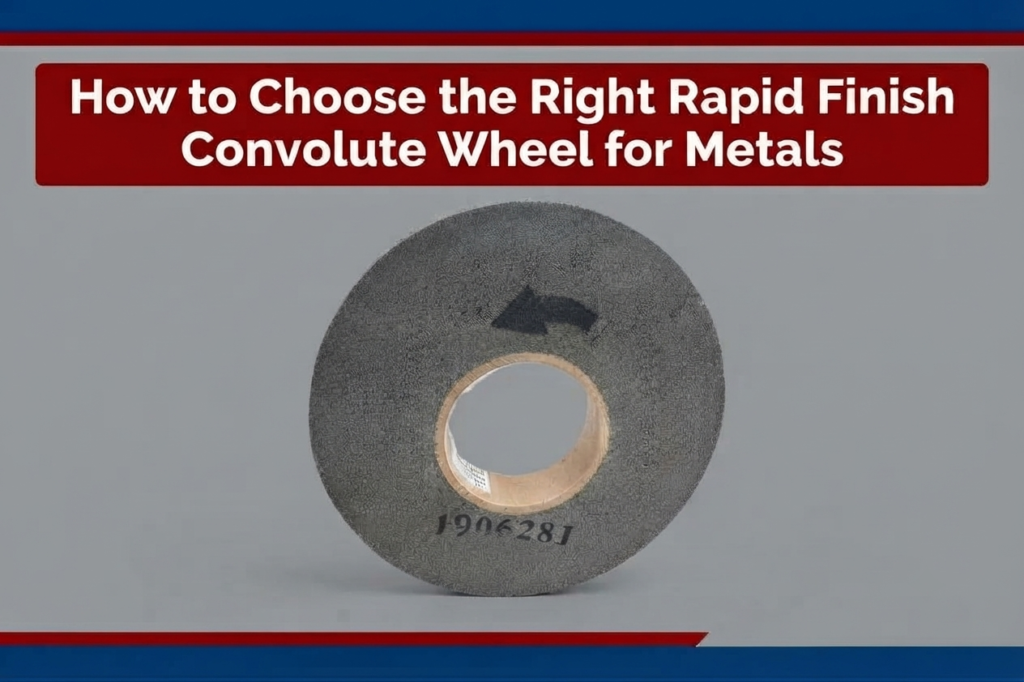
A Rapid Finish Convolute Wheel is a non-woven abrasive disc constructed from nylon web impregnated with uniform abrasive grains, engineered for deburring, blending, and imparting uniform satin or decorative finishes on metals without altering critical dimensional tolerances. By leveraging resilient web structures that resist loading and dissipate frictional heat, industrial facilities achieve consistent micro-inch surface finishes (Ra) while reducing secondary rework cycles by up to 40%.
Key Takeaways for Industrial Stakeholders
- [For CFOs/Buyers]: Specifying the correct density and grain size minimizes part rejection rates, lowers overall cost-per-part through extended wheel longevity, and secures stable tier-pricing alignment via Supra Industries’ bulk wholesale catalogs.
- [For Plant/Product Managers]: Matching operational RPM limits and durometer ratings to specific substrates eliminates thermal discoloration, reduces vibration harmonics, and guarantees compliance with ISO 9001:2015 manufacturing standards.
Comparative Analysis: Standard Deburring Media vs. Supra Industries Rapid Finish Convolute Wheels
| Technical Metric | Conventional Deburring Wheel / Low-Tier Alternative | Supra Industries Rapid Finish Convolute Wheel |
| Technical Threshold | Prone to fiber shedding, uncontrolled stock removal, and localized gouging. | Controlled, non-loading nylon web structure with uniform grain dispersion. |
| Operational Lifespan | Rapid thermal degradation; requires frequent dressing and replacement. | Extended lifecycle due to open-web heat dissipation and anti-loading resins. |
| TCO Impact | High frequency of machine downtime, frequent retooling, and elevated scrap rates. | Reduced downtime, lower total cost of ownership, and optimized throughput velocity. |
| Procurement Risk | High variance in batch quality and inconsistent durometer specifications. | Strict batch traceability, ISO-compliant manufacturing, and reliable supply chain lead times. |
Understanding Convolute Wheel Material Science
Convolute wheels are manufactured by wrapping layers of non-woven nylon web around a central core, bonding them under controlled heat and pressure, and curing them with specialized resins. This construction dictates how the wheel interacts with metal substrates under dynamic load.
- The open-web configuration prevents swarf accumulation, eliminating the heat-trapping loading common in bonded solid wheels.
- Uniform grain impregnation ensures that fresh abrasive edges are continuously exposed as the nylon matrix wears away evenly.
- Dynamic balance calibration minimizes axial runout, protecting high-speed CNC finishing spindles from premature bearing wear.
Selecting the appropriate wheel requires a rigorous evaluation of the workpiece material, required micro-finish, and operational parameters. Engineers must balance grain type—typically Aluminum Oxide for general ferrous metals or Silicon Carbide for non-ferrous alloys—with the appropriate density rating.
Evaluating Density and Hardness Ratings
Wheel density—typically measured on a scale from 2 (soft, highly conformable) to 9 (hard, aggressive edge retention)—dictates how the wheel reacts to contoured geometries versus flat surfaces.
- Low-Density Wheels (2–4): Ideal for highly contoured parts, complex stampings, and delicate aerospace components where edge preservation and contour conformity take precedence over heavy stock removal.
- Medium-Density Wheels (5–6): The industrial standard for general-purpose deburring, blending weld seams, and creating consistent linear satin finishes on stainless steel and carbon steel.
- High-Density Wheels (7–9): Engineered for aggressive edge breaking, heavy burr removal, and applications requiring rigid face contact without wheel deformation under high pressure.
Operational Parameters and Safety Guidelines
Maximizing wheel performance and maintaining operator safety requires strict adherence to rotational speed tolerances and thermal thresholds. Operating outside specified parameters leads to premature structural failure and compromised surface integrity.
- Always verify that the maximum operating speed (RPM) of your right-angle grinder or bench lathe matches or exceeds the rated RPM stamped on the wheel flange.
- Maintain controlled feed pressures; excessive manual downward force collapses the nylon web, generates localized thermal spikes, and induces micro-cracking in heat-sensitive alloys like titanium.
- Monitor ambient workspace humidity and storage conditions to prevent resin embrittlement over extended inventory storage cycles.
Commercial Procurement and Engineering Consultation
Integrating high-performance surface conditioning media into your plant’s workflow requires alignment with robust supply chains. Supra Industries provides comprehensive support for industrial procurement teams, offering volume tier pricing, dedicated technical support for custom arbor hole sizing, and rapid-dispatch inventory options
Optimize your plant’s surface preparation workflow today. Request a Bulk Wholesale Quote or explore our complete Industrial Abrasives Catalog to connect with an application engineer.